
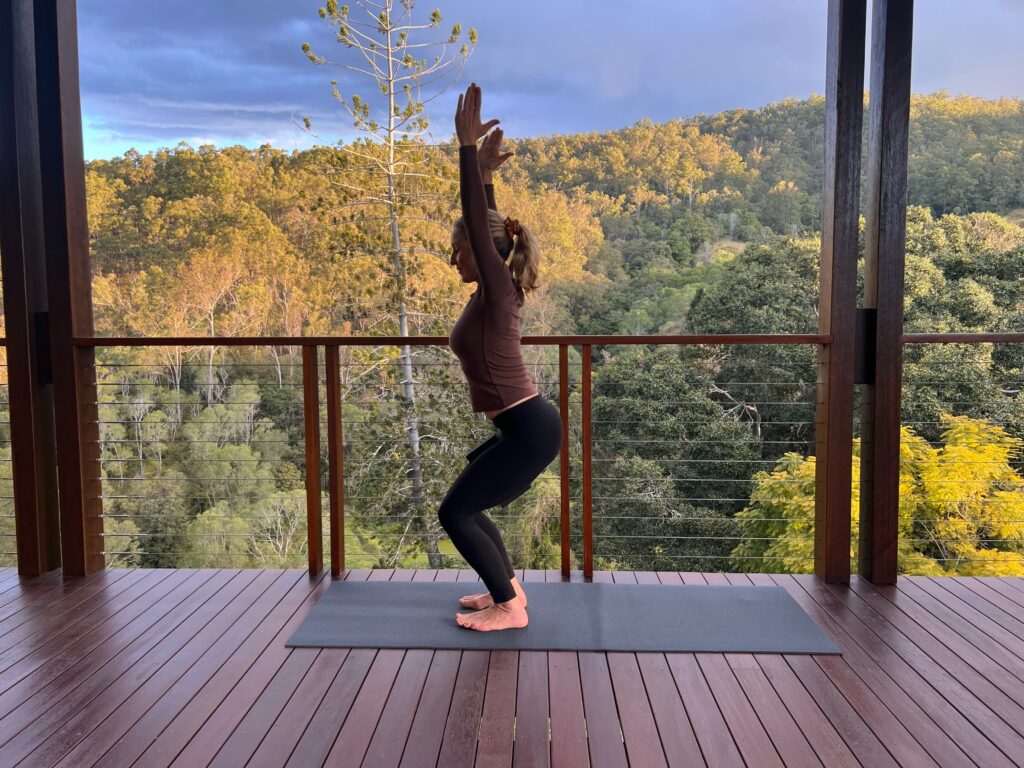
Chair Pose. Utkata refers to fierce, powerful or uneven. This pose or asana is like you are sitting on an imaginary chair.
How to Perform Utkatasana
1. Stand in the pose of Tadasana. With an inhalation, raise your arms and keep them perpendicular to the ground. You can either keep your hands parallel, facing inward or join them.
2. During exhalation, bend your knees and move your thighs as parallel to the ground as you can possibly move. Your knees move over your feet, and your upper body will move forward slightly over your hips until the front of your upper body is roughly perpendicular to your upper thighs. Push the heads of both the thigh bones down towards the ground or heels, keeping the inner thighs parallel.
3. Keep your shoulder blades firmly against your back. Push your tailbone down and towards the ground and pubis so that the lower back is stretched.
4. Stay in this pose for 30-60 seconds. Come back by straightening your knees during inhalation and strongly lifting through the arms. During exhalation, bring your arms back to your sides into Tadasana.
Utkatasana Benefits
Western Physiology
Utkatasana has a therapeutic effect on mental and physical health.
- Utkatasana improves mental health:
- It improves mood and sleep patterns (Innes et al., 2012).
- Utkatasana stretches and strengthens the muscles:
- It helps in strengthening the calves, ankles, thighs and spine (Kanjirathingal et al., 2021).
- It helps in stretching the chest and shoulders.
- It helps in stimulating the diaphragm, heart and abdominal organs.
- It helps in removing stiffness from the shoulders.
- Other therapeutic effects of Utkatasana include but are not limited to:
- It helps with building the arch in flat feet.
- It prevents the strain to the cardiovascular system (Bernotiene et al., 2020).
- It improves the blood pressure among patients with restless legs syndrome (Innes et al., 2012).
Yogic Physiology
This posture is good for removing kapha from the lower limbs, chest and heart. It opens the chest and mind and keeps the heart and lung areas open. It works on the flow of vyana vayu in its half form and in its full form, vyana vayu. It increases pitta in the body due to the use of muscle strengthening in the legs, mamsa strota.
Chinese Medicine
It affects the central meridian line, the heart and lung meridian lines of the arms. The pose will also affect to a degree all the meridians of the legs: liver, gallbladder, kidney lines.
Contradictions and Cautions
Individuals suffering from headaches, insomnia and low blood pressure should not do this pose.
Preparatory Asanas
- Virasana
- Bhujangasana
- Adho Mukha Svanasana
Follow up Asanas
Tips for Beginners
To help yourself stay in this asana, practise it against a wall. Stand with your back against a wall, a few inches from the wall. Try adjusting your position relative to the wall so that when you bend in this position, your tailbone is just touching and supported by the wall.
Variations
Bending your knees, rise on the balls of your feet and sit with your buttocks on raised heels. Stretch your arms forward, and make sure they are parallel to each other and the ground, palms down or in.
Modifications and Props
You can increase the strength of your hips by holding a yoga block between them during the pose.
Deepen the Asana
The secret to doing Utkatasana comfortably is to let go of the heads of the thighs towards the heels. Once you get in the position, bring your hands to your hips. Press the palms’ bases into the groin folds and push the thighs’ heads towards the heels, digging deep into the floor with the heels. Contrary to these actions, raise the sitting bones to the pelvis.
References
Innes KE, Selfe TK. The Effects of a Gentle Yoga Program on Sleep, Mood, and Blood Pressure in Older Women with Restless Legs Syndrome (RLS): A Preliminary Randomized Controlled Trial. Evid Based Complement Alternat Med. 2012;2012:294058. doi: 10.1155/2012/294058.
Kanjirathingal JP, Mullerpatan RP, Nehete G, Raghuram N. Effect of Yogasana Intervention on Standing Balance Performance among People with Diabetic Peripheral Neuropathy: A Pilot Study. Int J Yoga. 2021 Jan-Apr;14(1):60-70. doi: 10.4103/ijoy.IJOY_75_20.
Bernotiene G, Slapsinskaite A, Berškienė K, Daunoravičienė A, Vainoras A, Razón S. Yoga’s Effects on the Cardiovascular System of Healthy Women: Implications for Best Practices. Altern Ther Health Med. 2020 Sep;26(5):18-26. PMID: 32663177.
If you would like to contact Celia to learn more about the meditation teacher training journey, please do visit our Meditation Teacher Training Page or find us on Facebook or Instagram or contact Celia directly.