
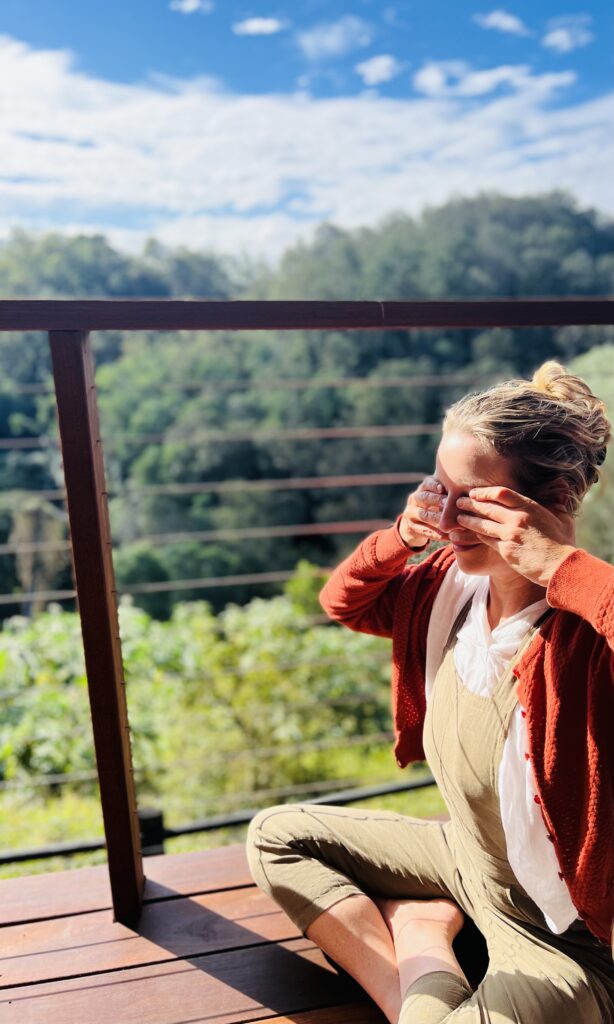
Bhramari, or “bumble bee” breath, supports a meditative state through its rhythmicity and calming effect.
Current research has discovered that bhramari when regularly practised…
- improves lung capacity and breath efficiency, including enhanced peak expiratory flow, forced expiratory flow, and vital capacity[1,2]
- alleviates chronic rhinosinusitis[3]
- improves heart rate patterns, such as a reduced heart rate[4,5]
- decreases systolic and diastolic blood pressure[6,7]
- supports longevity and immunity[4]
- quickens reaction time[8,9]
- sharpens the stress response (by heightening short-term stress response to pain and then expediting the decline of that response)[10]
- may stimulate high-frequency gamma and theta wave activity in the brain, which can support cerebral functioning[11]
- promotes the release of nasal nitric oxide[12]
- increases parasympathetic nervous system dominance[13]
Contraindications
Bhramari should not be performed while lying down. People suffering from severe ear infections should not practise this prânâyâma until the infection has cleared up.
Instructions
This exercise engages the vocal cords in an extended, calming breath.
Beginning posture: Padmasana or siddhasana/siddha yoni asana, with the elbows raised to the height of the head, index or middle finger gently plugging the ears. (Alternatively, the flaps of the ears may be pressed without inserting the fingers.) The jaw is relaxed, and the lips remain gently closed, with the teeth slightly separated, throughout the practice.
Variation: The position of nadanusandhana asana, used in nada yoga, may be utilised by sitting on a rolled blanket with the heels drawn up to the buttocks and placing the feet flat on the floor with knees raised and elbows resting on the knees. (For full details, refer to the Bihar School of Yoga’s publication Yoga and Kriya). In this position, the thumbs gently plug the ears, and the remaining four fingers of each hand rest on the head.
Breath shape: Diaphragmatic and full.
Rhythm: Slow and continuous.
Sound: The exercise gets its name from the female black bee. The sound produced on the exhale is a deep, steady, om-like sound.
Other Notes:
- The sound vibration will create distinct sensations in the brain.
- Variation: As an alternative practice, contract the throat while inhaling – as in ujjayi prânâyâma, only more strongly. In this way, a humming sound can be produced on inhalation as well as exhalation.
Awareness: Physical – on the humming sound within the head and on making the breath steady and even. Spiritual – on ajna chakra.
Duration: 5 to 10 rounds are sufficient, then slowly increase to 10 to 15 minutes. In cases of extreme mental tension or anxiety, or when used to assist the healing process, practise for up to 30 minutes.
Time of practice: The best time to practise is late at night or early morning, as there are fewer external noises to interfere with internal perception. Practising at this time also awakens psychic sensitivity. However, bhramari may be practised anytime to relieve mental tension, provided the surroundings are peaceful.
Advanced practice: Once the primary form of bhramari has been mastered, jalandhara and mula bandhas may be incorporated into the practice in conjunction with antara breath retention.
Guided Practice
Beginning in a comfortable seated meditation asana, let the hands rest on the knees in chin mudra or nana mudra. Close the eyes and relax the whole body for a short time.
When ready, raise the arms sideways and bend the elbows to plug the ears. Bring awareness to the centre of the head, where ajna chakra is located, and keep the body absolutely still.
Breathe in through the nose.
Exhale slowly and in a controlled manner while making a deep, steady humming sound, like that of the black bee. The humming sound should be smooth, even, and continuous for the duration of the exhalation.
The sound should be soft and mellow, making the front of the skull reverberate.
This is one round.
At the end of exhalation, breathe in deeply and repeat the process. Perform 5 rounds.
References
1. Kuppusamy M, Dilara K, Ravishankar P, Julius A. Effect of Bhrāmarī Prāṇāyāma Practice on Pulmonary Function in Healthy Adolescents: A Randomized Control Study. Anc Sci Life. 2017;36(4):196. doi:10.4103/ASL.ASL_220_16
2. Mooventhan A, Khode V. Effect of Bhramari pranayama and OM chanting on pulmonary function in healthy individuals: A prospective randomized control trial. Int J Yoga. 2014;7(2):104. doi:10.4103/0973-6131.133875
3. Abishek K, Bakshi SS, Bhavanani AB. The Efficacy of Yogic Breathing Exercise Bhramari Pranayama in Relieving Symptoms of Chronic Rhinosinusitis. Int J Yoga. 2019;12(2):120. doi:10.4103/IJOY.IJOY_32_18
4. Trivedi GY, Saboo B. Bhramari Pranayama – A simple lifestyle intervention to reduce heart rate, enhance the lung function and immunity. J Ayurveda Integr Med. 2021;12(3):562-564. doi:10.1016/J.JAIM.2021.07.004
5. Kuppusamy M, Kamaldeen D, Pitani R, Amaldas J. Immediate effects of Bhramari pranayama on resting cardiovascular parameters in healthy adolescents. Journal of Clinical and Diagnostic Research. 2016;10(5):CC17-CC19. doi:10.7860/JCDR/2016/19202.7894
6. Pramanik T, Pudasaini B, Prajapati R. Immediate effect of a slow pace breathing exercise Bhramari pranayama on blood pressure and heart rate. Nepal Medical College Journal. 2010;12(3):154-157.
7. Sathe S, Thodge K, Rajandekar T, Agrawal A. To find out immediate effect of bhramari pranayama on blood pressure, heart rate and oxygen saturation in hypertensive patients. Int J Curr Res Rev. 2020;12(19):193-197. doi:10.31782/IJCRR.2020.121919
8. Kuppusamy M, Kamaldeen D, Pitani R, et al. Effect of Bhramari pranayama practice on simple reaction time in healthy adolescents – A randomized control trial. Int J Adolesc Med Health. 2021;33(6):547-550. doi:10.1515/IJAMH-2019-0244/MACHINEREADABLECITATION/RIS
9. Rajesh S, Ilavarasu J, Srinivasan T. Effect of Bhramari Pranayama on response inhibition: Evidence from the stop signal task. Int J Yoga. 2014;7(2):138. doi:10.4103/0973-6131.133896
10. Maheshkumar K, Dilara K, Ravishankar P, et al. Effect of six months pranayama training on stress-induced salivary cortisol response among adolescents-Randomized controlled study. EXPLORE. 2022;18(4):463-466. doi:10.1016/J.EXPLORE.2021.07.005
11. Vialatte FB, Bakardjian H, Prasad R, Cichocki A. EEG paroxysmal gamma waves during Bhramari Pranayama: A yoga breathing technique. Conscious Cogn. 2009;18(4):977-988. doi:10.1016/J.CONCOG.2008.01.004
12. Taneja MK. Nitric oxide Bhramari Pranayam and deafness. Indian Journal of Otology. 2016;22(1):1. doi:10.4103/0971-7749.176507
13. Kuppusamy M, Kamaldeen D, Pitani R, Amaldas J, Shanmugam P. Effects of Bhramari Pranayama on health – A systematic review. J Tradit Complement Med. 2018;8(1):11-16. doi:10.1016/j.jtcme.2017.02.003
If you would like to contact Celia to learn more about the meditation teacher training journey, please do visit our Meditation Teacher Training Page or find us on Facebook or Instagram or contact Celia directly.