
The ancient text of Yoga Sutras, compiled by the sage Patanjali, provides insights into the historical use of plant medicine in yoga. Patanjali’s first sutra of the fourth chapter suggests that spiritual attainments can be attained through certain medicinal plants, among other means, such as incantations, fervour, or meditation.
The sutra reads: “Janmauṣadhimantratapaḥsamādhijāḥ siddhayaḥ” (Sutra IV.1).
While there are various interpretations of this sutra, it is evident that Patanjali recognised the potential of medicinal plants in bestowing health and insight, which indicates that plant medicine was not only accepted but also integrated into the spiritual practices of ancient yogis.
Today, there is renewed interest in exploring the therapeutic potential of plant medicine, including psychedelic substances, in the context of yoga and meditation. The Multidisciplinary Association for Psychedelic Studies (MAPS) is one organisation leading the way in promoting research and education on the subject. The integration of plant medicine into modern yoga practices, as in ancient times, may hold promise in helping individuals achieve greater physical and spiritual well-being.
The historical use of plant medicine in yoga has been a subject of interest and debate for many years. In Patanjali’s Yoga Sutras, the first sutra of the fourth chapter describes the various means by which spiritual attainments can be gained, including medicinal plants. The text suggests that plant medicine can be a tool for awakening and gaining insight into one’s spiritual journey.
Yoga historian and Indiologist Georg Feuerstein further elaborates on using plant medicine in yoga. He notes that the ancient drink or brew known as “Soma” was used by sages and rishis to bestow health, communion, strength, and visionary wisdom. Soma was believed to have a consciousness-altering effect that brought forth “skilful visionary thought” in Vedic seers. The drink was often combined with mantra yoga, which involved prolonged and concentrated chanting in daily rituals.
In the Vedic tradition, Soma was regarded as the “nectar of the gods” or Amrita, which was believed to purify and heal the body while opening the inner landscape of heart and mind. The use of Soma and other entheogenic plants in ancient India is well documented in Rigveda, one of the oldest Hindu scriptures.
While the use of plant medicine in yoga is not without controversy, many scholars and practitioners believe that certain plants can be used in a sacred and intentional way to facilitate spiritual growth and healing. Ayahuasca, a traditional plant medicine from South America, has gained attention in recent years as a tool for spiritual and personal growth.
Moreover, the use of other entheogenic substances, such as psilocybin mushrooms, has been studied for their potential therapeutic benefits. Clinical studies have shown promising results in treating depression, anxiety, and addiction.
In Australia, the Therapeutic Goods Administration (TGA) has announced that from 1 July 2021, psychiatrists who are authorised under the Authorised Prescriber Scheme will be able to prescribe medicines containing psilocybin and MDMA for the treatment of post-traumatic stress disorder and treatment-resistant depression, respectively. The decision acknowledges the lack of options for patients with specific treatment-resistant mental illnesses and allows the use of psilocybin and MDMA in a controlled medical setting. The decision will also list psilocybin and MDMA as Schedule 8 (Controlled Drugs) medicines in the Poisons Standard, restricting their supply to clinical trials for all other uses. Psychiatrists will need to be approved under the Authorised Prescriber Scheme and prescribed the substances under strict controls that ensure the safety of patients. There are currently no approved products containing psilocybin or MDMA evaluated for quality, safety, and efficacy, but authorised psychiatrists will be able to access and legally supply a specified ‘unapproved’ medicine containing these substances to patients under their care for these specific uses.
In conclusion, plant medicine has a long and rich history in yoga. Using certain plants for medicinal and spiritual purposes is an area of interest and exploration for researchers and practitioners alike.
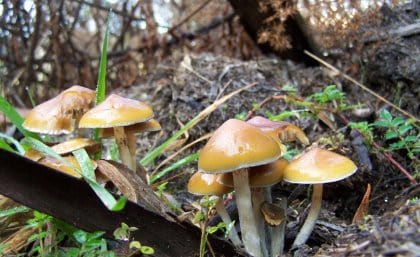
Image: Psilocybe subaeruginosa, photographed in Tasmania, is thought to be a magic mushroom that is native to Australia. Image: © Caine Barlow.
References
1. Feuerstein, G. (1998). The yoga tradition: Its history, literature, philosophy and practice. Hohm Press.
2. Rätsch, C. (2005). The Encyclopedia of psychoactive plants: Ethnopharmacology and its Applications. Park Street Press.
3. Schultes, R. E., & Hofmann, A. (1992). Plants of the gods: Origins of hallucinogenic use. Healing Arts Press.
4. Smith, F. (2004). The self-possessed: Deity and spirit possession in South Asian literature and civilisation. Columbia University Press.
If you would like to contact Celia to learn more about the meditation teacher training journey, please do visit our Meditation Teacher Training Page or find us on Facebook or Instagram or contact Celia directly.