
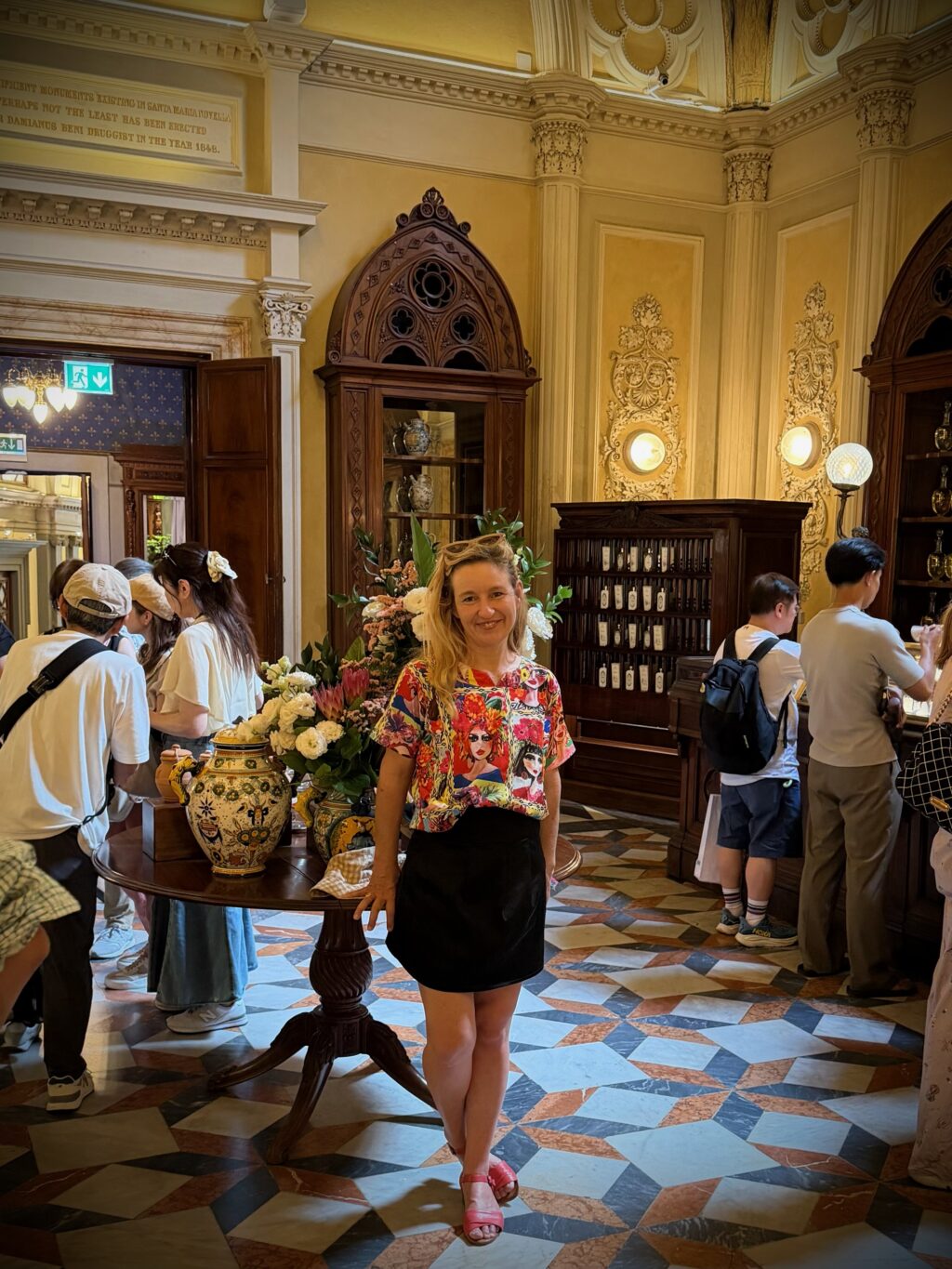
This image was taken at a monastic pharmacy in Italy. It reminds me of why I wanted to study complementary medicine long ago.
As a young woman, I felt drawn to study medicine after completing my biomedical science degree. I read a book about studying Western medicine: the enormous costs, the personal debt, and the cost to students’ health. In fact, the health of medical students in the USA declined by 70 per cent, and it often didn’t improve much after they left medical school. The stress started and never stopped.
Having already begun studying Eastern traditions of medicine, it was beautiful to see that healing others was never completely separated from the inner life of the healer. Ayurvedic medicine is one example. In the Vedic tradition, herbal medicine, contemplation, embodied prayer, alignment with nature and the cosmos, service, personal discipline, and the spiritual life of the whole person existed together.
In ancient India, the “pharmacy” was not a building, but the wilderness itself. Forest-dwelling ascetics, monks, and rishis served as the primary healers and doctors of their time, gathering wild herbs from the mountain forests they called home. As visionary sages, these rishis systematically observed nature, animal behaviours, and human biology, blurring the lines between scientist, priest, and physician. Urban seekers routinely journeyed to the forest to obtain remedies the ascetics had collected daily for patients. These medicines were believed to be spiritually charged, empowered by mantras, prayers, and the healer’s own intent and power – the kundalini shakti cultivated during deep meditation (Samadhi). Ultimately, healing was woven into a holistic worldview centered on alignment with nature: a philosophy that extended into homes and gardens, which were intentionally designed by Vastu Shastra to serve as sacred spaces for worship, rest, good health and recovery.
Yoga, Ayurveda and Psychosomatic medicine made sense to me. I knew this way of studying would teach me how to look after myself on every level, unlike the Western medical system, to which I may have given away my health. From that true place of embodied medicine came a contemplative spiritual understanding of health too: faith, trust and spirituality. From this place of true self-care and inner work, I knew I could offer this to others.
We may often try to treat people in medicine who aren’t willing to heal. Without their genuine desire to take responsibility for their healing journey, the patient may struggle to heal. It, in turn, exhausts the therapist. This is often very different in my line of work. My clientele and students tend to have a deep intrinsic care for themselves and their own spiritual path. It makes ALL the difference.
In Ayurveda, we learn about Karma, and we must be very careful not to take someone’s Karma away without their genuine willingness, because their suffering can be their grace. As Ram Dass says, we have no moral right to take someone’s suffering away. These teachings encourage us to be the witness, consciousness, “Saksha Bhavi”, not the doer, nor the healer, but the witness.
Perhaps this is one of the great differences between simply treating illness and understanding medicine as a path of healing.
In Ayurveda, we treat the underlying causes. We build up the system so it can cope with any intervention we give it.
WE NEVER just treat the symptom.
I feel we have reached a time in medicine where we are waking up to something new.
It’s happening in psychiatry, psychology, counselling and general practice.
The doctor needs to do the inner work. The patient does too.
Perhaps we are remembering something that traditional medicine, the monks and rishis understood long ago: healing is not only about what we give to the body, but how we live, how we relate to pain and suffering, how we understand ourselves, and the deep intention with which we care for another.
It’s a union of sorts.
A true Yoga.
Embodied Medicine Training: Yoga, Meditation, Somatic Medicine, Vedic & Buddhist Psychology
Modules endorsed by PACFA & RACGP
If you’re inspired to deepen your practice or expand your teaching pathway, BIYOME offers a comprehensive range of Yoga, Meditation, and Ayurveda training programs designed to support meaningful, embodied learning. You can also find us on Facebook or Instagram or contact Celia directly.