
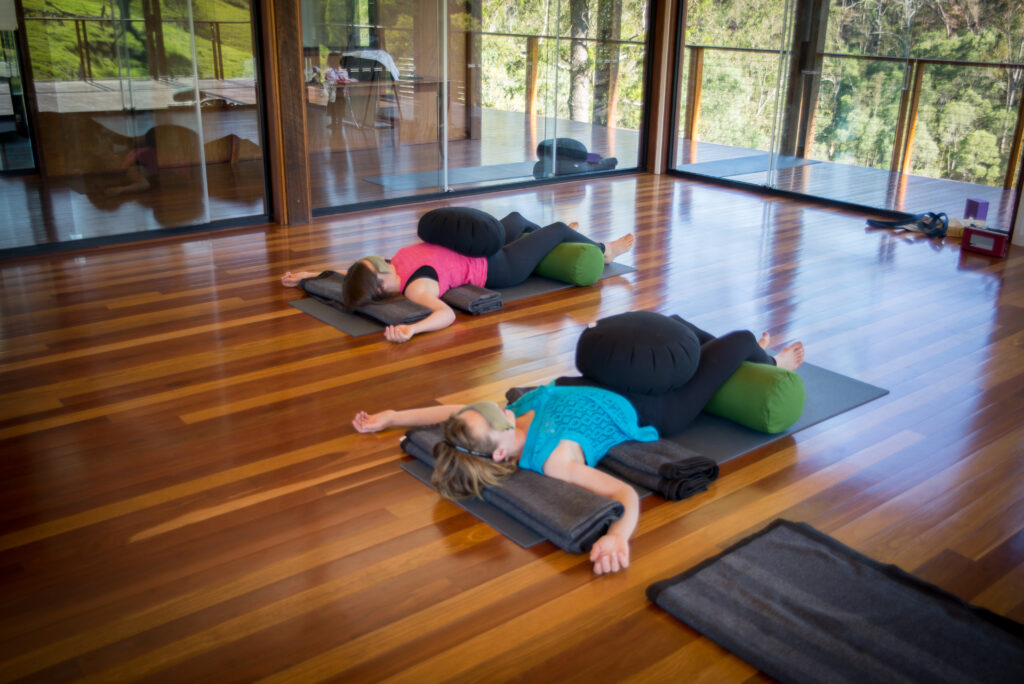
Viloma, or “stop-action” breathing, translates roughly to mean “against the natural order.” It breaks the natural breath pattern with regular interruptions to sharpen the practitioner’s focus and build breath control, building the capacity for breath flow to be directed more precisely.
Viloma can help to create a sense of ease and gentle exhilaration while soothing the nerves.
Contraindications
This exercise should not be practised by pregnant women or those with very high blood pressure. It also may not be suitable for those who struggle with high anxiety.
Instructions
This exercise requires precise intention and control throughout the practice.
Beginning posture: This is best performed in a supported reclining posture. It can also be done in a sitting or lying down posture.
Breath shape: Within each interruption (since the lungs are not filled completely), the inhaled breath can be targeted into a specific body area.
Rhythm: Each interruption should last for 1 to 2 seconds. Any number of interruptions can disrupt each breath phase. When beginning this practice, only one or two interruptions should be applied per breath phase. (For example, on the inhale, the lungs will be filled to only one-third or one-half capacity, interrupted, then sealed by another one-third or -half.)
Sound: This is a quiet practice.
Awareness: Physical – on the specific area where you direct the breath.
Other Notes:
- Interruptions may occur during the inhale, exhale, or both.
- Sapt-chakra viloma is a variation involving seven interruptions. During each pause, the attention is focused on a different energy centre (chakra), moving from the highest chakra (sahasrara) to the lowest (muladhara).
- Note that this practice is distinct from anuloma viloma, an advanced version of nâdî shodhana.
Duration: Repeat these breaths on a cycle for 1 to 4 minutes.
Advanced practice: The number of pauses can be increased as an advancement of the practice.
Guided Practice
Close the eyes, align the spine and relax the body. Breathe a few long, continuous breath cycles through the nose. Notice each wave of breath as it passes through the head, throat, and lungs.
When ready, draw in a breath that fills one-third of your lungs. Pause for two seconds.
Continue the inhale to fill another third of the lungs.
Pause for two seconds.
Take in one more inhale to fill the lungs.
Pause for two seconds.
Exhale in a slow, extended-release.
This is one round of a viloma inhalation. (Note: You can inverse these instructions with a normal inhale and a series of partial exhales or combine the two.)
Alternative Practice – Anuloma Viloma
Here we will briefly discuss an alternative pranayama technique, like nadi shodhana, known as anuloma viloma. The benefits of anuloma viloma are very similar to those of nadi shodhana. Research has shown that it can improve heart rate, systolic blood pressure, diastolic blood pressure, galvanic skin response, and respiratory rate[1]. Additionally, it has been shown to improve food metabolism[2] and reduce mental stress[3].
Anuloma viloma differs from nadi shodhana in that there is no need to hold your breath. Some practices of nadi shodhana involve holding the breath in-between inhalation and exhalation. In anuloma viloma, there is no breath-holding. In essence, they are very similar practices and provide similar health benefits.
References
1.Sharma B, Misra R, Singh K, Sharma R. Comparative Study of Effect of Anuloma-Viloma (Pranayam) and Yogic Asanas in Premenstrual Syndrome. Vol 57.; 2013.
2. Malhotra V, Tandon O, Patil R, et al. Suryanadi Anuloma Viloma Pranayama Modifies Autonomic Activity of Heart. 2009;8(1).
3. Solomon SG. Effect of anuloma and viloma pranayama on stress of nurses. International Journal of Advanced Psychiatric Nursing. 2022;4(1):7-11. doi:10.33545/26641348.2022.v4.i1a.74
If you would like to contact Celia to learn more about the meditation teacher training journey, please do visit our Meditation Teacher Training Page or find us on Facebook or Instagram or contact Celia directly.