
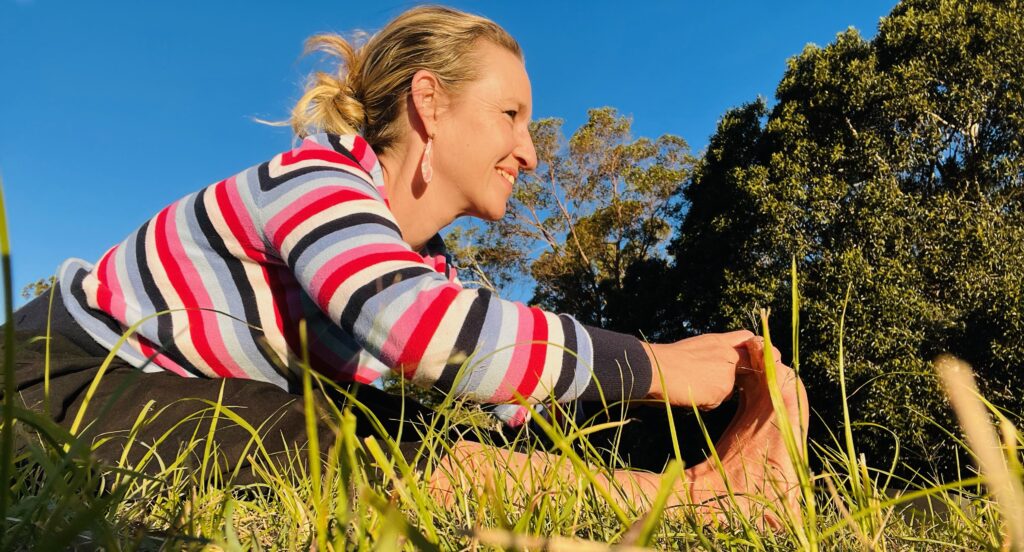
Derived from the root paschima = west, uttana = intense stretch and asana = pose. Paschimottanasana often is referred to as the “Seated Forward Bend” and the idea is that it stretches the “West side of the body” or the back of the body. It may have a calming and cooling influence on the mind and body.
How to perform Paschimottanasana
1. Sitting on the floor, extend your legs in front of your body. Place your palms on the ground by the side of your body or hips. Take a couple of softer and longer breaths.
2. During exhalation, stretch your hands forward and take hold of your toes. Hold the right toe between your right index finger, middle finger, and the thumb, and the left big toe between your left index finger, middle finger and the thumb.
3. Extend and stretch your spine and try to curve your upper back inwards or keep its position concave. Extend your arms upwards from the shoulders, keeping the biceps and ears aligned where possible. Gradually bend at the hips from the pelvis region, moving forward towards the feet. Extend from the lower back to the base of the head, lengthening the spine. Take in a few softer and longer breaths.
4. Now, during an exhalation, bend your elbows and widen them out to the sides, thereby using them as levers to pull the trunk forward. While doing so, touch your forehead to your knees if comfortable or alternatively rest the head on an object in front of you (block or bolster). Gradually, place your elbows on the ground for a more rested position, stretching your neck and upper torso and touching the knees first with your forehead.
5. Gradually, when you are able to find this position, or it becomes easier for you, you can place further effort by holding the soles and resting your chin on your knees or a block.
6. When you are able to do this version of the pose, too, clasp your hands together by interlocking the fingers and rest your chin on your lower leg/shin further away from your knees.
7. When the above becomes easy, hold your right palm with your left hand or vice versa beyond the outstretched feet while keeping your back concave. Take a couple of soft and long breaths.
8. Rest your chin on the lower legs or shins further away from your knees during an exhalation.
9. When you can easily achieve this position, hold the left wrist with the right hand or vice versa and rest your chin on the lower legs or shins further away from the knees.
10. Ensure that the back of your legs and the back of your knee joints are placed on the floor during this pose. It may happen that during the initial stages, the knee joint may be lifted off the ground. Contract the muscles of the back of the thighs by squeezing the heel bones to the sit bones, creating resistance, and move your upper torso forward. This will invite the back of the knee joint to rest on the ground, but do be mindful if this causes any pain and modify the pose by bending the knees.
11. Try and hold any of the aforementioned positions described above for around 1-5 minutes or 5-30 breaths. Breathe softly and quietly normally during this time reducing the ratio of your breath to about 5 to 6 breaths per minute to induce the relaxation response.
12. In advanced stages, you may be able to stretch and extend your hands straight ahead and rest your palms on the ground, joining your thumbs of both hands beyond the outstretched feet while keeping your chin on the lower legs further away from the knees. Breathe evenly and stay in this pose for 1-2 minutes. Alternatively, you could hold one or two bricks beyond the feet and reach for them to extend your practice and provide better proprioceptive feedback.
13. During an inhalation, move the arms upright and above the head whilst lifting the body back to seated. Sit quietly and induce the science of calm by focusing on your outbreath and inner body.
Paschimottanasana Benefits
Western Physiology
Paschimottanasana has a therapeutic effect on mental and physical health.
- Paschimottanasana improves mental health in many ways:
- It helps calm the brain and relieve the symptoms of stress and mild depression (Cowen & Adams, 2005; Guner & Inanici, 2015).
- It helps in soothing the symptoms of anxiety (B. et al., 2017; Guner & Inanici, 2015).
- This pose, in tandem with others, can help increase memory, given its effects on calming the mind (Velvizhi, 2019).
- This pose, in tandem with others, may help improve sleep quality (Mustian et al., 2013).
- Paschimottanasana benefits the reproductive health in several ways:
- It helps improve the symptoms of both menstrual discomfort (Sri et al., 2020) and menopause.
- It has a therapeutic effect on infertility (Mohseni, et al., 2021).
- It helps in curing impotence and increasing vitality by improving the blood circulation to the pelvic region (“Yoga for Erectile Dysfunction”, 2022).
- It helps stimulate the ovaries and uterus (Guner & Inanici, 2015).
- Paschimottanasana benefits metabolism:
- It is helpful with flatulence and constipation (B. et al., 2017).
- It helps stimulate the liver and kidneys (B. et al., 2017; Guner & Inanici, 2015).
- This pose, in tandem with others, helps reduce fasting serum glucose levels and post-prandial serum glucose levels in patients with Diabetes mellitus (Kumar, 2004).
- It reduces obesity (Ravi, S. & Sangeeta, G. (2014).
- It also helps in improving digestion (“A GUIDE TO BACK STRETCH POSE (PASCHIMOTTANASANA) – Popular Vedic Science”, 2022).
- Paschimottanasana stretches and strengthens the muscles:
- It helps stretch the shoulders, spine and hamstrings (B. et al., 2017; Guner & Inanici, 2015).
- It helps improve flexibility (Bal, Baljinder S: Kaur, 2009; Cowen & Adams, 2005).
- This pose strengthens the back and legs (Guner & Inanici, 2015).
- Other therapeutic effects of Paschimottanasana include but are not limited to:
- It helps soothe headaches and reduce fatigue (Guner & Inanici, 2015).
- This pose, in tandem with others, may be helpful for ulcerative colitis (Cramer et al., 2017).
- This pose, in tandem with others, helps improve diastolic blood pressure (Cowen & Adams, 2005).
- It massages the heart, the spinal column and organs of the abdominal cavity, thereby keeping them refreshed (“A GUIDE TO BACK STRETCH POSE (PASCHIMOTTANASANA) – Popular Vedic Science”, 2022).
Yogic Physiology
- According to Ayurveda, this posture has a calming and cooling effect on the body and mind and is therefore very good for reducing heat or pitta. It is particularly effective for vata (calming) and pitta (cooling) types.
- This posture is excellent for the flow of apana vayu – the downward flowing prana from the lower back to the feet. It removes waste products from the pranic field and therefore, the body and mind.
- This downward flowing prana governs reproductive health, lower colon health, health of the bladder and urethra. It also has the effect of calming the mind and reducing mental waste. The outbreath or focus on exhalation will accentuate the downward flow.
Contradictions and Cautions
- This pose should not be done by individuals suffering from asthma and diarrhea.
- In case you are suffering from a back injury, then it is recommended that you do the pose in the presence of an experienced trainer or if only mild back pain, bend the knees.
Preparatory Asanas
Follow up Asanas
- Ardha Matsyendrasana
- Bharadvajasana
Tips for Beginners
Never force yourself to lean forward, especially when sitting on the floor. Once you feel the space between your pubis and navel is shortening, stop, lift slightly, and lengthen again. Often, due to stiffness of the muscles in the back of the legs, the beginner’s forward lean does not go very far forward and may more resemble an upright sitting position. Place a folded blanket underneath the sit bones for the best angle of the hips and to reduce strain.
Variations
Urdhva Mukha (urdhva derived from Sanskrit meaning upward; mukha meaning face) Paschimottanasana.
Lying on your back, exhale and try to bend your knees into the torso. Then inhale and stretch your heels towards the ceiling. Slowly rotate your feet toward the floor above your head as you exhale. Some are able to reach all the way to the floor, while others are not. Do not lift the back of your pelvis too far off the floor – this is an upside-down version of Paschimottanasana, not Salamba Sarvangasana or Halasana.
Modifications and Props
Most students in this pose should sit on a folded blanket, and most beginners should keep the strap around their legs to hold when coming forward. Students who are highly constrained may place a rolled-up blanket or towel or even a bolster under the knees.
Chair Yoga: This posture can also be performed seated on a chair and folding forwards over the legs or bolster resting vertically on the legs.
Deepen the Asana
When you are fully leaning forward, you can straighten your elbows again. There are several ways to do this. One way is to clasp your hands around the soles of your feet or turn the back of one hand toward the soles and hold it by the wrist with your other hand. You can also place one or two blocks on the soles of your feet and hold the edges with your hands.
References
Cowen, V. S., & Adams, T. B. (2005). Physical and perceptual benefits of yoga asana practice: Results of a pilot study. Journal of Bodywork and Movement Therapies, 9(3), 211–219. https://doi.org/10.1016/j.jbmt.2004.08.001
Guner, S., & Inanici, F. (2015). Yoga therapy and ambulatory multiple sclerosis Assessment of gait analysis parameters, fatigue and balance. Journal of Bodywork and Movement Therapies, 19(1), 72–81. https://doi.org/10.1016/j.jbmt.2014.04.004
B., M. R., Sukumar, B. S., Tripathy, T. B., & R., R. K. (2017). Management of Haemorrhoids (Arsha) with Yogic Life Style. Journal of Ayurveda and Integrated Medical Sciences (JAIMS), 2(05). https://doi.org/10.21760/jaims.v2i05.10267
Velvizhi, S. (2019). the Effect of Yogic Practice Enhances Memory Among Student Teachers. 4(7), 245–247. www.ijsdr.org
Mustian, K. M., Sprod, L. K., Janelsins, M., Peppone, L. J., Palesh, O. G., Chandwani, K., Reddy, P. S., Melnik, M. K., Heckler, C., & Morrow, G. R. (2013). Multicenter, randomized controlled trial of yoga for sleep quality among cancer survivors. Journal of Clinical Oncology, 31(26), 3233–3241. https://doi.org/10.1200/JCO.2012.43.7707
Sri, P. W., Sandy, J., Sujana, W., Angga, A., Program, P., Keperawatan, S., Tinggi, S., Buleleng, I. K., Raya, J., Sanih, A., & Km, N. (2020). TERAPI PASCHIMOTTANASANA DAN ADHO MUKHA PADMASANA TERHADAP INTENSITAS NYERI PADA REMAJA PUTRI YANG MENGALAMI DISMENORE PRIMER. In Jurnal Ilmiah Permas: Jurnal Ilmiah STIKES Kendal (Vol. 10, Issue 3). https://doi.org/10.32583/PSKM.V10I3.779
Mohseni, M., Eghbali, M., Bahrami, H., Dastaran, F., Amini, L. (2021) Yoga Effects on Anthropometric Indices and Polycystic Ovary Syndrome Symptoms in Women Undergoing Infertility Treatment: A Randomized Controlled Clinical Trial. Evidence-Based Complementary and Alternative Medicine. https://doi.org/10.1155/2021/5564824
Yoga for Erectile Dysfunction. (2022). Retrieved 3 June 2022, from https://www.healthline.com/health/erectile-dysfunction/yoga-for-erectile-dysfunction
Bal, Baljinder S:Kaur, P. J. (2009). Effects of Selected Asanas in Hatha Yoga on. Sport Health, 1(may), 75–87.
Kumar, K. (2004). A Study on the Effect of Yogic intervention on serum glucose level on Diabetics. International Journal of Yoga and Allied Sciences, 1, 1. http://indianyoga.org/wp-content/uploads/2013/02/v1-issue1-article9.pdf
Ravi S., Sangeeta G. (2014). Response of Paschimottanasana and Kapalabhati on anthropometric parameters in obese individuals as per Prakriti. International Journal of Research in Ayurveda and Pharmacy 5(3):256-260. https://doi.org/10.7897/2277-4343.05352
A GUIDE TO BACK STRETCH POSE (PASCHIMOTTANASANA) – Popular Vedic Science. (2022). Retrieved 3 June 2022, from https://popularvedicscience.com/yoga/a-guide-to-back-stretch-pose-paschimottanasana/
Cramer, H., Schäfer, M., Schöls, M., Köcke, J., Elsenbruch, S., Lauche, R., Engler, H., Dobos, G., & Langhorst, J. (2017). Randomised clinical trial: yoga vs written self-care advice for ulcerative colitis. Alimentary Pharmacology & Therapeutics, 45(11), 1379–1389. https://doi.org/10.1111/apt.14062
If you would like to contact Celia to learn more about the meditation teacher training journey, please do visit our Meditation Teacher Training Page or find us on Facebook or Instagram or contact Celia directly.