
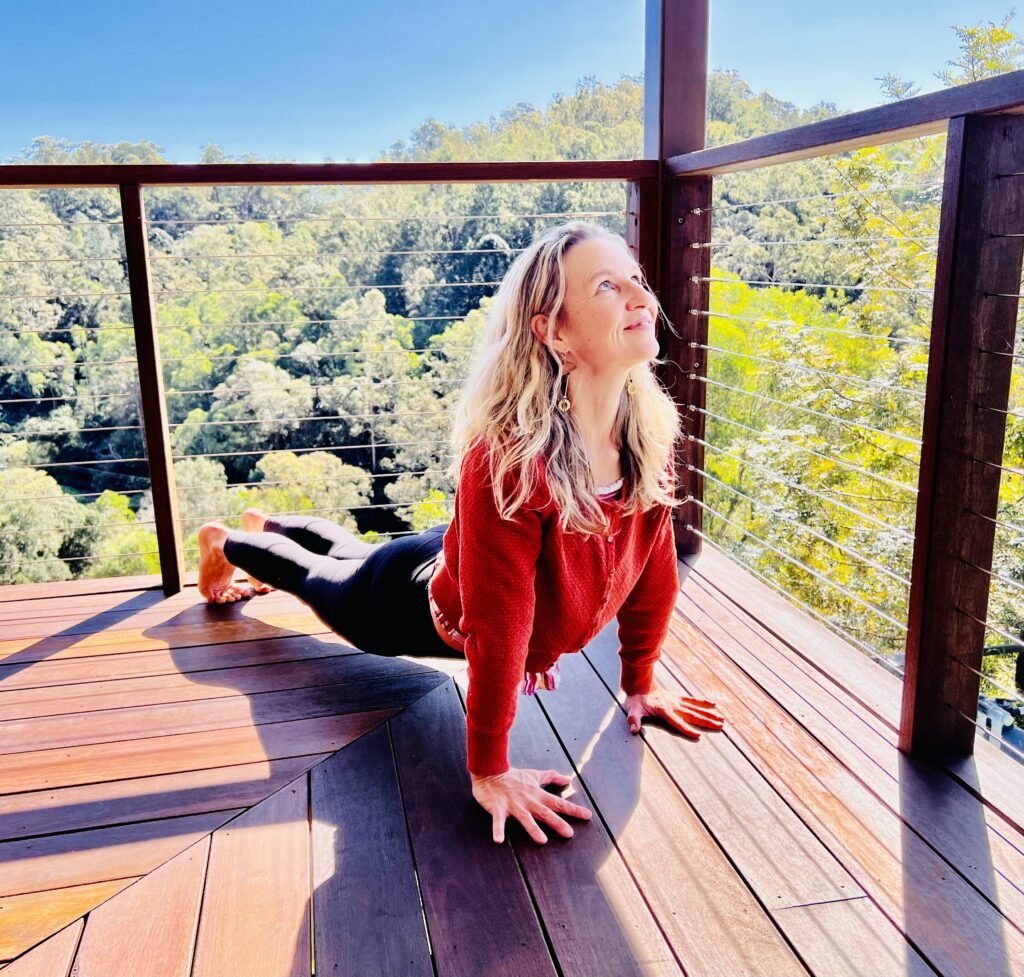
Urdhva Mukha refers to keeping the mouth in the upward direction. Svana refers to a dog. This asana resembles a stretching dog with its head up, hence the name.
How to perform Urdhva Mukha Shvanasana
1. Lie on the ground on the abdomen, face facing downwards.
2. Place your feet one foot apart, toes pointing straight back. Place your palms on the ground at the sides of your waist, with the fingers of both hands pointing towards your head. Suction your hands up off the ground ever so slightly against gravity.
3. During an inhalation, raise your torso and head upwards, stretching and extending both arms completely. Try and avoid locking the elbows or hyperextending. Draw the upper torso and head back, but counter this movement in the neck by keeping the neck long and back of neck muscles engaged. Create a bandha in the feet by pushing them into the ground, towards the earth. This can occur by pointing the toes and pressing the top of the foot down to the earth (plantar flexion) or by flexing the toes towards the front of the knees and pressing the tips of the toes into the earth (dorsiflexion).
4. Ensure you keep your legs straight and strong at the knee joints, and you may choose to avoid placing the knees on the ground. In this stronger position, your body weight rests on your toes and palms.
5. Your thighs, calves and spine should be stretched and extended completely, and the hips should be tightly contracted by squeezing through the inner thighs. Push your chest in the forward direction, stretching your neck entirely and take your head back whilst keeping the neck long and neck muscles engaged. The back of the arms should also be stretched, but not hyperextended. Hold this pose for about 30 to 60 seconds and continue breathing deeply. While coming back, bend your elbows, relax the stretch and rest on the ground.
Urdhva Mukha Shvanasana Benefits
Western Physiology
Urdhva Mukha Shvanasana has a therapeutic effect on mental and physical health.
- Urdhva Mukha Shvanasana improves mental health:
- It helps in relieving the symptoms of mild depression (Bower et al., 2011).
- Urdhva Mukha Shvanasana stretches and strengthens the muscles:
- This pose, in tandem with others, strengthens and stretches the abdominal muscles, and improves cardiorespiratory endurance (Lau et al., 2015).
- Urdhva Mukha Shvanasana benefits the spine:
- This pose helps rejuvenate the spine and is recommended for individuals who suffer from back stiffness.
- It helps individuals who suffer from lumbago and sciatica pain.
- It also helps relieve the slipped disc and prolapsed discs of the spine.
- Other therapeutic effects of Urdhva Mukha Shvanasana include but are not limited to:
- It helps with fatigue (Bower et al., 2011).
Yogic Physiology
This posture is said to elevate the heart and mind by stimulating udana vayu. It harmonises pitta, regulates samana vayu and stimulates agni. It has a calming effect on vata in the colon whilst improving circulation and peristalsis in the region.
The posture places pressure on Nabhi (navel) and Basti (bladder) Marmas bringing Pranic flow to these regions of the body. It opens Anahata Akash (the heart space) and the heart maram points (hridaya marma). It opens the KUM region of the body, bridging a sense of lightness to the whole body and mind. This posture is similar to cobra or Bhujangasana, which stimulates kundalini, whose energy is like a cobra.
Chinese Medicine
This posture stimulates the spleen and stomach meridian lines. The posture affects the two main meridians: the Ren (Conception) and the Du (Governing), which run down the centre of the body.
Contradictions and Cautions
- People with back injuries, carpal tunnel syndrome and headaches should avoid this asana.
- It should also be avoided during pregnancy.
Preparatory Asanas
- Bhujangasana
- Setu Bandha Sarvangasana
Follow up Asanas
- Backbends
- Urdhva Mukha Shvanasana will help you learn to lift your chest in postures such as Tadasana and Virasana.
Tips for Beginners
This pose tends to “hang” on the shoulders, which lifts them to the ears and “turtle” neck. Pull the shoulders away from the ears, stretch along your back armpits and tighten underneath them, pull your shoulder blades toward your coccyx and push your side ribs forward. If you need help learning this, raise each hand to a block to create a little more space for extension of the spine.
Modifications and Props
It is often difficult to keep the legs strongly suspended above the floor. Before moving into the pose, place a thick blanket roll under your upper thighs. When you are in the pose, rest your hips lightly on this roll, pressing your tailbone closer to the roll.
Deepen the Asana
To increase lightness and strengthen this asana, push off from the back of your knees along your calves and out through your heels. The tops of your feet will press harder against the floor; while lifting the top of the sternum up and forward.
Further Benefits
- It strengthens the spine and relieves pain in the back.
- It helps in expanding the chest and provides elasticity to the lungs.
- It helps improve the blood flow to the pelvic organs and maintains their health.
- It helps in improving the posture.
- It strengthens the arms and wrists.
- It helps in firming the buttocks.
- It stimulates the organs situated in the abdominal cavity.
- It acts as a therapeutic for asthma.
References
Bower JE, Garet D, Sternlieb B. Yoga for persistent fatigue in breast cancer survivors: results of a pilot study. Evid Based Complement Alternat Med. 2011;2011:623168. doi: 10.1155/2011/623168.
Lau C, Yu R, Woo J. Effects of a 12-Week Hatha Yoga Intervention on Cardiorespiratory Endurance, Muscular Strength and Endurance, and Flexibility in Hong Kong Chinese Adults: A Controlled Clinical Trial. Evid Based Complement Alternat Med. 2015;2015:958727. doi: 10.1155/2015/958727.
If you would like to contact Celia to learn more about the meditation teacher training journey, please do visit our Meditation Teacher Training Page or find us on Facebook or Instagram or contact Celia directly.