
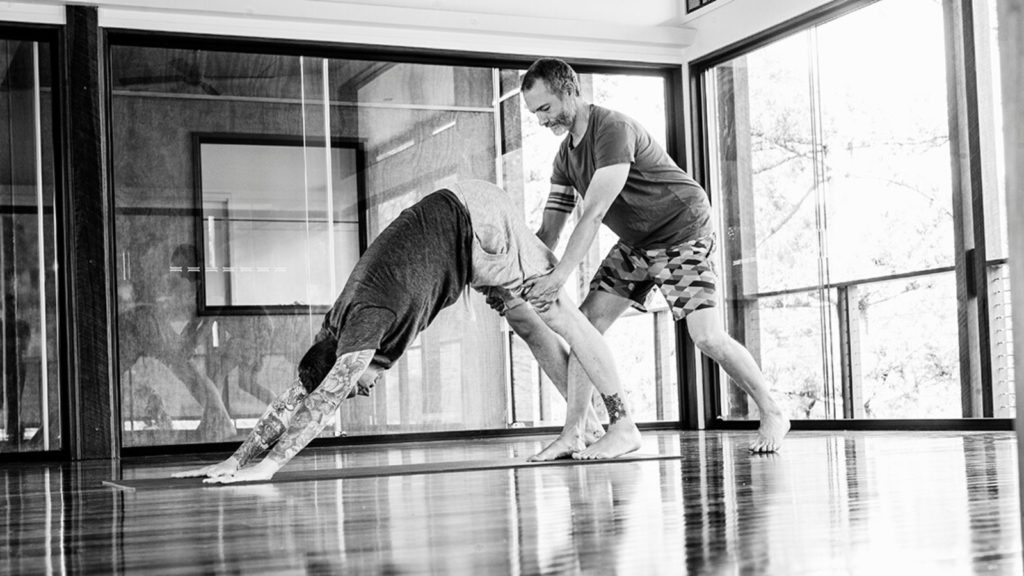
Derived from the roots Adho = down, Mukha = face, Svana = dog. Thus, Adho Mukha refers to keeping the face in the downwards direction. Additionally, this pose seemingly resembles a dog stretching with its head and forelegs in the downward direction and the hind legs in the upward direction, hence its full name.
How to perform Adho Mukha Svanasana
1. Rest in a child’s pose on the ground with the arms outstretched. Place your palms to the ground, shoulder-width apart. Have the middle finger facing forward and draw an imaginary straight line between the thumbs, stretching out through the webbing of all the fingers and the anatomical snuff box between the index finger and thumb. Suction through the centre of the palms to protect the wrists, practising ha hasta bandha. This will also assist in scapular stabilisation. By suctioning through the centre of the palm, you may stimulate a marma point called Tala-Hridaya marma, which governs the flow of prana from the heart to the hands, assisting the movement of Vyana Vayu, which may help in circulating lymph and blood around the body, according to yogic physiology. We can refer to the science of psycho-neuro-immunology from a more scientific standpoint. Focusing mindful attention on the body’s limbs may increase the blood and lymphatic flow. This understanding comes from the science of psycho-neuro-immunology. We can try to control blood flow through yoga asana, breathing and even our emotional states, so relax into a down-face dog and practice self-compassion.
2. When you come up to the down-face dog, keep your chest and heart close to the ground to strengthen the shoulders. Avoid throwing your body weight forward when you raise the hips. Avoid moving the feet forward on the floor as you come up from the child’s pose. Use the child’s pose foot placement to down-face dog movement to determine the distance of your feet from your hands. You can spread your legs slightly shoulder-width apart, but do not push them forward. Instead, challenge your hamstrings and keep your heels on the ground, even if they don’t touch.
3. Allow your head to hang so that your biceps and ears align. Use the support of a bolster under the head if you wish.
4. The legs could be kept straight, with the quadriceps intensely engaged. “For example, in a downward-facing dog (Adho Mukha Svanasana), there is often a sensation of “tightness” in an area like the hamstrings. However, it may not be the hamstring’s fault from a mechanical restriction perspective. Instead, it could be a motor control problem wherein the person can’t find their hip flexors to help pull them into more flexion at the hip. Another possibility is that the hamstrings need to learn how to lengthen eccentrically without perceiving threat or guarding. And if flexibility is the goal, we know that eccentric contractions can contribute to flexibility while increasing strength. A win-win.” (Source)
5. For others, the knees could be kept deliberately bent to increase the load on the hamstring TENDONS and create better tensile strength longer term. Do note that: “Protecting the hamstrings tendons from injury based on knee joint angle is not a consideration because hamstring tendon strength is not dependent on knee joint angle. Hamstring tendon strength is dependent on the loading history of those tissues.” (Source)
6. The feet can be held parallel to each other, the big toes are pressed against each other, and the heels are moved away from each other. This provides a gentle Bandha on the thighs, Kati Bhandha.
7. The soles of the feet and heels may be geared towards resting on the ground but don’t make that the ultimate goal.
8. Hold this pose for at least 60 seconds while breathing gently into a soft belly. Exhale to complete the pose and return the body to the child’s pose.
Adho Mukha Svanasana Benefits
Western Physiology
Adho Mukha Svanasana has therapeutic effects on mental and physical health.
- Adho Mukha Svanasana improves mental health in many ways:
- It helps relieve the stress and symptoms of mild depression and anxiety (Innes & Selfe, 2012).
- Adho Mukha Svanasana, in tandem with other asanas, positively affects mood and stress perception (Innes & Selfe, 2012).
- Adho Mukha Svanasana is said to be helpful for insomnia. Whilst there is little evidence to support this claim directly from the posture itself, the inversion will induce the relaxation response as the baroreceptors in the neck to reduce heart rate when it is recognised that the head is below the heart. A longer out-breath practised here will also assist the relaxation response and lower stress levels. A novel study shows that yoga can help improve sleep in people with chronic insomnia, and “evening yoga practice was associated with a significant improvement in sleep efficiency and a reduction in the frequency of individual nights of insomnia” (Innes & Selfe, 2012).
- Adho Mukha Svanasana stretches and strengthens the muscles:
- Adho Mukha Svanasana stretches the hamstrings, calves, back muscles and fascia (Wang et al., 2012).
- Adho Mukha Svanasana strengthens your quadriceps and ankles and can assist with creating better arches for those who suffer from fallen arches, foot collapse or flat foot.
- Adho Mukha Svanasana strengthens the arms and wrists when practised correctly, providing a better range of motion in the shoulder joint (Wang et al., 2012, Kirk et al.,2006).
- This pose activates the abdominal muscles, namely, rectus abdominis, external oblique, and transversus abdominis (Rathore et al., 2017).
- Adho Mukha Svanasana has a beneficial effect on the cardiovascular system:
- Adho Mukha Svanasana, in tandem with other asanas, helps reduce the heart rate due to the mild inversion (Innes & Selfe, 2012).
- Adho Mukha Svanasana, in tandem with other asanas, may help reduce high blood pressure (Innes & Selfe, 2012).
- Other therapeutic effects of Adho Mukha Svanasana include but are not limited to:
- This inversion may be very helpful in relieving headaches. Inversions are fantastic for those who suffer tension headaches caused by vasodilation (usually 90 per cent!). Headaches of tension variety are often caused by vasodilation of the arterial vessels. Inversions will decrease arterial dilation by slowing the heart rate. Dilation of arteries and arterioles leads to an immediate decrease in arterial blood pressure and heart rate. This gentle inversion is a perfect start to the recovery from headaches.
- Adho Mukha Svanasana may also assist sciatica by tensioning the sciatic nerve.
- Adho Mukha Svanasana may assist in reducing chronic pain if within the patient’s range of motion, employing mindfulness techniques in the area of the body that is experiencing pain. Research also shows us that compassion meditation may also be employed to reduce back pain. This can be used during the practice of down-face dogs (Crow et al., 2015).
- Adho Mukha Svanasana may increase the circulation of lymph. This clear, watery fluid moves through the body, picking up bacteria and viruses and filtering them out via the lymph nodes. The lymph moves with muscular contractions.
- This pose, in combination with others, increases the levels of ApoA1 and adiponectin. Both play a critical role in lipid metabolism and determine the prognosis of various conditions such as colorectal cancer, diabetes, and heart disease (Papp et al., 2016).
- The gentle inversion will also affect the movement of lymph which is also affected by gravity. Whenever your head is below your heart, lymph moves into the respiratory organs, where germs (bacteria, viruses, fungi, and protozoa) often enter the body. Gravity drains the lymph upon returning to an upright position, sending it through your lymph nodes for cleansing. Breathe through your nose for best results, which will increase nitric oxide (NO). NO is involved in the health and function of the nervous system, having the incredible ability to kill bacteria and viruses.
- Adho Mukha Svanasana improves focus (Kirk et al., 2006).
Yogic Physiology
- Adho Mukha Svanasana helps in recovery from fatigue, and the inversion restores pranic energy or flows in individuals who may be physically exhausted.
- Adho Mukha Svanasana restores the flow on Udana prana from the heart to head through the inversion.
- Adho Mukha Svanasana restores the flow of Vyana Vayu from the heart to the limbs.
- Adho Mukha Svanasana may be helpful in healing headaches, sinusitis, tinnitus and depression as it may increase the flow of Tarpaka Kapha, the Kapha around the head and sinuses.
Contradictions & Cautions
- Individuals suffering from carpal tunnel syndrome or sore wrists should avoid this pose.
- During pregnancy, avoiding this pose in the later stages is wise unless practised regularly before the pregnancy.
- Adho Mukha Svanasana causes an increase in intraocular pressure. Therefore, should be cautioned against people who have cataracts or detached retina. “A new study found that when people did head-down poses, their IOP increased within one minute of each pose. The increase remained throughout each two-minute pose, and then IOP returned to baseline within two minutes of the person sitting down. ‘For people with glaucoma, the optic nerve is somewhat compromised. Once the nerve becomes damaged, its ability to withstand repeated acute IOP elevations is reduced,’ says Murray Fingeret, O.D., chief of the optometry section, Brooklyn/St. Albans Campus, Department of Veterans Administration, at New York Harbor Health Care System, and a founding member and past president of the Optometric Glaucoma Society. This article shows that when a person puts himself in a position where his or her head is down, the eye pressure rises, and the eye pressure rises quite rapidly. You’re looking at a greater than 10-point increase that occurs almost immediately.” (Source; Jasien et al., 2015).
- Adho Mukha Svanasana can cause an increase in intracranial pressure (ICP). Therefore, should be cautioned against people who have brain aneurysms, tumours or strokes or symptoms associated with increased ICP.
- Those with high blood pressure who are not on medication should be careful with this pose.
Preparatory Asanas
- Adho Mukha Virasana
- Uttanasana
- Plank Pose
Counter Asanas
- Standing Poses
- Uttanasana
- Headstand
- Adho Mukha Virasana
Tips for Beginners
If you have difficulty with the range of motion of your shoulders in the pose, raise your hands above the floor for a couple of blocks leaning against and supported by the wall. Alternatively, place your hands on the seat of a metal folding yoga chair.
Variations
You can lift one leg high for 30 seconds on each side, changing posture to Eka Pada Adho Mukha Svanasana, one leg upside down dog.
Modifications and Props
Head and Neck:
Place a bolster under the head to support the head and neck and relax the scalp muscles and the neck.
Shoulders:
Take a yoga belt or strap to your elbows, loop and secure it around your arms just above your elbows.
For those who hyperflex at the elbow joint, it is best to use a strap and press the elbows into the belt in an outward motion. This will prevent long-term damage to the ligaments and bones of your elbow.
For those wishing to increase the range of motion in the shoulder joint and have resistance in this area, you want to move the elbows away from the belt and try to loosen the belt as you externally rotate the upper arm.
For those hyper-flexible in the shoulder joint, place two blocks, one under each forearm and one left of the forearm, away from the bricks to increase strength in the shoulder muscles and prevent hyperflexion.
Wrists:
If your wrists are in pain when practising, roll the mat up in front of you and place the heel of the hand on the rolled mat and the fingers on the floor to elevate the wrist angle.
Hips:
Raise your feet on bricks to elevate the hips. Really lift from the front of the hips and carry the weight down into the feet. Alternatively, have someone lift you from the upper thigh or hip region with their hands or a belt to assist in taking weight from the wrists and shoulders.
Deepen the Asana
To increase the lift of your spine, lift the shin bones.
Try and lift the inner ankle to the outer ankle to increase the arch support of the feet. Lift the inner knees, the inner groins and the pelvic floor.
Hold a brick between the thighs and squeeze. Line up the knees directly over the big toes to avoid excessive internal rotation, especially for those who have knock knees.
Try and practice internal rotation of the upper arm in the down-face dog.
Teacher Adjustments
References
Jasien, J. V., Jonas, J. B., de Moraes, C. G., & Ritch, R. (2015). Intraocular Pressure Rise in Subjects with and without Glaucoma during Four Common Yoga Positions. PloS one, 10(12), e0144505. https://doi.org/10.1371/journal.pone.0144505
Innes, K. E., & Selfe, T. K. (2012). The Effects of a Gentle Yoga Program on Sleep, Mood, and Blood Pressure in Older Women with Restless Legs Syndrome (RLS): A Preliminary Randomized Controlled Trial. Evidence-based complementary and alternative medicine : eCAM, 2012, 294058. https://doi.org/10.1155/2012/294058
Wang, M. Y., Greendale, G. A., Kazadi, L., & Salem, G. J. (2012). Yoga Improves Upper-Extremity Function and Scapular Posturing in Persons with Hyperkyphosis. Journal of yoga & physical therapy, 2(3), 117. https://doi.org/10.4172/2157-7595.1000117
Kirk M, Boon B, Di’Turo D. Champaign, IL: Human Kinetics; 2006. Hatha Yoga Illustrated For Greater Strength, Flexiblity and Focus; p. 17. 26, 30, 54-56, 60-61, 70-71, 100, 140-1.
Rathore, M., Trivedi, S., Abraham, J., & Sinha, M. B. (2017). Anatomical Correlation of Core Muscle Activation in Different Yogic Postures. International journal of yoga, 10(2), 59–66. https://doi.org/10.4103/0973-6131.205515
Crow, E. M., Jeannot, E., & Trewhela, A. (2015). Effectiveness of Iyengar yoga in treating spinal (back and neck) pain: A systematic review. International journal of yoga, 8(1), 3–14. https://doi.org/10.4103/0973-6131.146046
Papp, M. E., Lindfors, P., Nygren-Bonnier, M., Gullstrand, L., & Wändell, P. E. (2016). Effects of High-Intensity Hatha Yoga on Cardiovascular Fitness, Adipocytokines, and Apolipoproteins in Healthy Students: A Randomized Controlled Study. Journal of alternative and complementary medicine (New York, N.Y.), 22(1), 81–87. https://doi.org/10.1089/acm.2015.0082
If you would like to contact The BioMedical Institute of Yoga and Meditation by Celia Roberts to learn more about the Yoga teacher training journey, please do visit our Yoga Teacher Training Page or find us on Facebook or Instagram or contact Celia directly.
Yoga Teacher Training Courses
© Celia Roberts
All research and literature based on original documents written by Celia Roberts. This manual and the information contained within it is not to be copied, replicated, or distributed without permission. Images and additional information has been sourced from Light on Yoga by B.K. Iyengar, yogajournal.com, yogajournal.com.au for your convenience.
Further Sources