
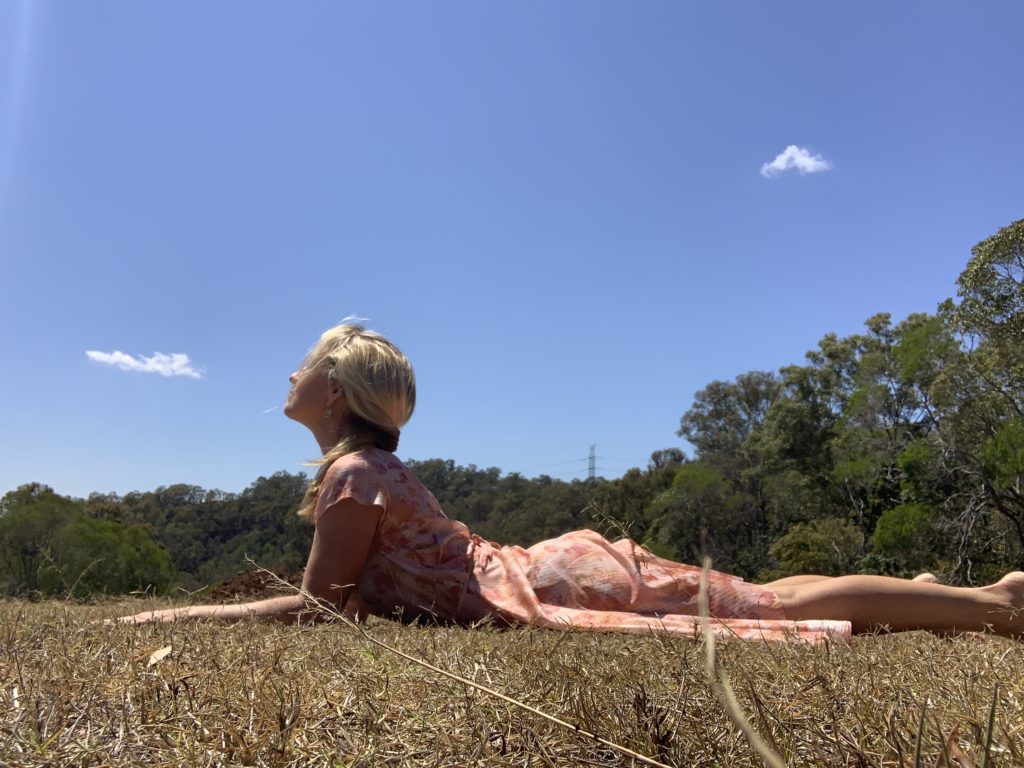
Derived from the roots, Bhujanga = snake, and asana = posture. Thus, Bhujangasana means to be in the posture of the snake. We often refer to this as the Cobra Pose (Dr Jyoti Gangwal et al., 2019). This posture is characterized by lying on the ground with the back bent and pointing upward towards the sky.
How to perform Bhujangasana
1. Lie on the ground face down (prone) on a blanket. Lengthen and stretch the back of your legs and the tops of your feet. Keep elbows hugged to the body and palms flat on the ground below the shoulders.
2. Press the thighs, tops of the feet (including the little toe) and pubis gently into the ground.
3. On inhale, straighten the arms to lift the chest off the ground. Gently refrain at the height whereby the pubis and lower body are still grounded. Let the tailbone extend upwards and lift as evenly as the upper body lifts, pivoting at the level of S1. (This can help reduce counter-nutation).
4. Pull up the pubis toward the navel. Decrease the distance between the points of the thighs. Tighten your buttocks, but avoid excessive muscle tension. Find a place of stability and lightness.
5. Bring your shoulder blades to the back, squeezing them together gently and allowing the side ribs to move forward. Elevate the sternum, but avoid bringing the front ribs forward, as this will only harden the lower back region. The backbend or extension must be distributed evenly throughout the length of the spine.
6. Breathe easily in this pose for 15-30 seconds to open the chest and lungs. Exhale and return to the starting position.
Bhujangasana Benefits
Western Physiology
Bhujangasana has therapeutic effects on mental and physical health.
- Bhujangasana improves mental health:
- Bhujangasana helps in relieving stress and fatigue (Colgrove et al., 2019; Dr Jyoti Gangwal et al., 2019).
- Bhujangasana stretches and strengthens the muscles:
- It helps in stretching shoulders, abdomen, chest and lungs.
- This pose helps firm the buttocks (Dr Jyoti Gangwal et al., 2019).
- Bhujangasana benefits the spine:
- It helps strengthen and rejuvenate the spine and is recommended for those with a stiff back (Rakhshaee, 2011; Rathore et al., 2013; Sumchai, 2015).
- It helps strengthen and extend the neck and upper part of the back (Guner & Inanici, 2015).
- This pose diminishes kyphosis (Morse, 2007).
- It helps relieve pain from sciatica (Dr Jyoti Gangwal et al., 2019).
- Bhujangasana improves respiration processes:
- Aids strengthen muscles that assist in exhalation, making it therapeutic for individuals with asthma (Morse, 2007).
- It opens the lungs and heart (Dr Jyoti Gangwal et al., 2019).
- Other therapeutic effects of Bhujangasana include but are not limited to:
- This pose, in tandem with others, decreases the risk of cardiovascular diseases via improving BMI and regulating blood pressure (Balaji et al., 2012; Chauhan et al, 2017).
- This pose, in tandem with others, has a positive effect on diabetics by helping lower insulin levels and improving fat redistribution and glucose utilization (Malhotra et al., 2005).
- It helps stimulate the organs in the abdominal region (Dr Jyoti Gangwal et al., 2019).
- Improves menstrual irregularities (Dr Jyoti Gangwal et al., 2019) and can help with painful menstrual periods (dysmenorrhea) (Rakhshaee, 2011).
- The pose causes abdominal compression, which may help relieve constipation (Morse, 2007; Sinclair, 2011).
Yogic Physiology
- It elevates the mind and heart.
- It stimulates Udana Vayu.
- It places pressure on Nabhi (navel) and Basti (bladder) Marmas bringing Pranic flow to these regions of the body.
- It opens Anahata Akash (the heart space).
- It opens the KUM region of the body, bridging a sense of lightness to the whole body and mind.
- It is mentioned in traditional texts that Bhujanhasana increases body heat, kills disease and awakens kundalini.
Chinese Medicine
This posture works the Spleen and stomach meridians along the front of the body, also the main central and governing channels and the heart and small intestine meridians of the arms.
Contradictions and Cautions
- Do not perform this pose during pregnancy.
- Avoid practicing this pose in the case of:
- back injury
- headache
- carpal tunnel syndrome
Preparatory Asanas
- Setu Bandha Sarvangasana
- Urdhva Mukha Shvanasana
- Salabhasana
Follow up Poses
- Backbends of your choice
Tips for Beginners
Don’t overdo the backbend or any extension of the spine. Finding a height where you can feel comfortable and not strain your back is best. Take your hands off the floor for a moment, so the height you find is through extension, not the pressure you place on the hands.
Modifications and Props
If your back feels stiff, avoiding doing this pose on the floor may be best. Place a metal folding chair against the wall. Then perform the pose with your hands on the front edge of the seat and toes on the floor. Practice on a bolster to make it harder to balance whilst performing the pose. Use bricks under the hands and draw them into the body to increase the spine’s extension. Do remember to bring your shoulders down and away from the ears.
Deepen the Asana
If your armpits, chest and groin are flexible, you can move deeper into the backbend. To do so, walk the hands a little farther forward and straighten your elbows, turning the arms outward. Life the top of the sternum upwards toward the ceiling, keeping the back of the neck long.
Further Benefits
This pose is recommended to alleviate lumbago and prolapsed discs of the spine because this pose increases the flexibility of the spine. This pose, alongside other postures, is therapeutic for patients with asthma (Vedanthan et al., n.d.). It helps increase the blood circulation in the pelvic region and keeps the organs in the pelvis healthy (Dr Jyoti Gangwal et al., 2019). The research suggests that gentle daily back strengthening work is often considered better than back surgery in recovering from chronic lower back pain. As Professor Lorimer Moseley states, ‘movement is king’ in the recovery from chronic pain.
References
Dr. Jyoti Gangwal, Kholiya, Dr. S., Bhatnagar, Dr. V., & Lahange, Dr. S. M. (2019). Importance of Bhujangasana in Daily Life. International Journal of Trend in Scientific Research and Development, 4(1), 646–651. https://www.ijtsrd.com/papers/ijtsrd29662.pdf%0Ahttps://www.ijtsrd.com/medicine/ayurvedic/29662/importance-of-bhujangasana-in-daily-life/dr-jyoti-gangwal
Colgrove, Y., Gravino-Dunn, N., Dinyer, S., Sis, E., Heier, A., & Sharma, N. (2019). Physical and physiological effects of yoga for an underserved population with chronic low back pain. International Journal of Yoga, 12(3), 252. https://doi.org/10.4103/ijoy.ijoy_78_18
Rakhshaee, Z. (2011). Effect of Three Yoga Poses (Cobra, Cat and Fish Poses) in Women with Primary Dysmenorrhea: A Randomized Clinical Trial. Journal of Pediatric and Adolescent Gynecology, 24(4), 192–196. https://doi.org/10.1016/j.jpag.2011.01.059
Rathore, M., Mb, S., Trivedi, S., & Siddiqui, A. U. (2013). An Anatomical Insight into the Biomechanics of Cobra Posture. Undefined.
Sumchai, A. P. (2015). The Human Spine is like a Precious Strand of Pearls. Journal of Womens Health Care, 04(05), 1–8. https://doi.org/10.4172/2167-0420.1000258
Guner, S., & Inanici, F. (2015). Yoga therapy and ambulatory multiple sclerosis Assessment of gait analysis parameters, fatigue and balance. Journal of Bodywork and Movement Therapies, 19(1), 72–81. https://doi.org/10.1016/j.jbmt.2014.04.004
Morse, D. (2007). Yoga for Asthma. International Journal of Yoga Therapy, 17(1), 81–88. https://doi.org/10.17761/ijyt.17.1.a4228q443v020h52
Balaji, P. A., Varne, S. R., & Ali, S. S. (2012). Physiological effects of yogic practices and transcendental meditation in health and disease. North American journal of medical sciences, 4(10), 442–448. https://doi.org/10.4103/1947-2714.101980
Chauhan, A., Semwal, D. K., Mishra, S. P., & Semwal, R. B. (2017). Yoga Practice Improves the Body Mass Index and Blood Pressure: A Randomized Controlled Trial. International journal of yoga, 10(2), 103–106. https://doi.org/10.4103/ijoy.IJOY_46_16
Malhotra V, Singh S, Tandon OP, Sharma SB. The beneficial effect of yoga in diabetes. Nepal Medical College Journal : NMCJ. 2005 Dec;7(2):145-147. PMID: 16519085.
Sinclair, M. (2011). The use of abdominal massage to treat chronic constipation. Journal of Bodywork and Movement Therapies, 15(4), 436–445. https://doi.org/10.1016/j.jbmt.2010.07.007
Vedanthan, P. K., Kesavalu, L. N., Murthy, K. C., Duvall, K., Hall, M. J., Baker, S., & Nagarathna, S. (n.d.). Clinical Study of Yoga Techniques in University Students with Asthma: A Controlled Study.
Watch + Learn: Cobra Pose. (2022). Yoga journal. http://www.yogajournal.com/poses/471