
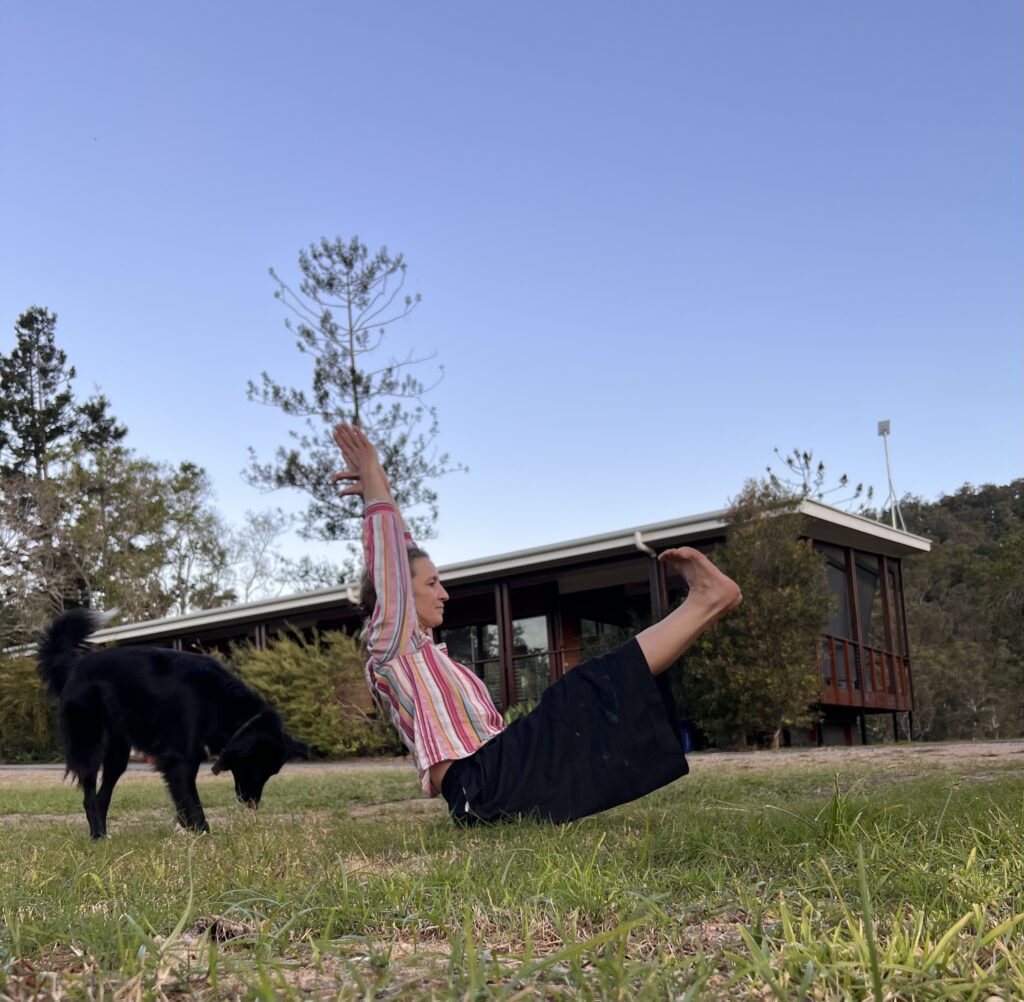
Derived from the root nava = boat, and asana = pose. Thus, Navasana translates to “Boat Pose”.
How to perform Navasana
1. Sit on the ground and extend your leg straight in front of you.
2. Interlock the fingers of both hands and place them on the back of the head just above the neck area.
3. During an exhalation, take your upper torso backwards while raising your legs from the ground. Take care to keep your knees tight, and your toes pointed. In this position, the balance of your whole body is placed on your hips, and no part of your spinal column should touch the ground. You should feel the grip and pressure on the abdominal and lower back muscles.
4. In this pose, your feet should be at an angle of about 30-35 degrees to the ground, and the top of your head (crown) should be in line with your toes.
5. Stay in this position for 20-30 seconds while breathing normally. If you can stay in this position for 1 minute, then this implies that you have strong abdominal muscles.
6. Ensure that you do not hold your breath during this pose. It is the usual tendency to suspend your breath after an inhalation.
7. There are two varieties of Navasana: Ardha Navasana and Paripurna Navasana. The difference between them is that in the latter, the legs are moved higher towards the abdomen, reducing the distance between them and the abdomen compared to the former pose.
Navasana Benefits
Western Physiology
Navasana has a therapeutic effect on mental and physical health.
- Navasana improves mental health:
- This pose helps alleviate stress (Cowen & Adams, 2005; Guner & Inanici, 2015).
- Navasana benefits the metabolism:
- Paripurna Navasana stimulates the intestines (Guner & Inanici, 2015; Tekur et al., 2012).
- This pose helps in improving digestion (Laxman, 2022).
- This pose, in tandem with breathing practices and other asanas, helps to lose weight and reduce waist circumference (McDermott et al., 2014).
- Navasana stretches and strengthens the muscles:
- This pose helps bring vigour and life to the back, especially the lower part of it. Allowing you to age comfortably and gracefully.
- The pose helps improve the strength of the back muscles. Initially, the back cannot bear the straightening of this pose, which improves gradually with practice as the back strengthens (Guner & Inanici, 2015). This is especially beneficial for females and helps in childbearing.
- It helps in strengthening the abdomen (Akademia & Fizycznego, 2016), hip flexor, and the legs and thigh muscles (Akademia & Fizycznego, 2016; Guner & Inanici, 2015).
- Only 12 weeks of regular practice of this pose in combination with others improves cardiovascular endurance and muscle flexibility (Lau et al., 2015).
- Ardha Navasana, in tandem with other poses, helps with lower back pain (Tekur et al., 2012).
- Other therapeutic effects of Navasana include but are not limited to:
- Ardha Navasana stimulates the kidneys, thyroid and prostate glands (Guner & Inanici, 2015; Laxman, 2022; Tekur et al., 2012).
- This pose improves pelvic blood flow (Mangala Gowri et al., 2022).
- This pose benefits patients with diabetes mellitus and those with liver, gallbladder, or spleen disorders (Mangala Gowri et al., 2022).
Yogic Physiology
This posture builds the energy of the third chakra, manipura chakra, translated as “the city of jewels”. It is therefore considered to be helpful in affecting digestive organs, confidence, strength and resilience. It strengthens and massages Nabhi marma – a large marma point that governs digestion at the navel point. It also affects the central nadi – sushumna.
Chinese Medicine
The concentration of energy is in the middle Jiao, san jiao, between diaphragm and navel, containing the spleen and stomach organs, which govern the function of digestion and absorption of food. It also affects the central meridian line, Ren.
Contradictions and Cautions
- Individuals suffering from diarrhoea, asthma, heart problems, low blood pressure, insomnia, and headaches should avoid this pose.
- You should also avoid this pose during menstruation and pregnancy.
- In case you suffer from a neck injury, perform this pose by sitting with your back near a wall.
- While tilting your upper torso backwards, the back of your head should rest on the wall.
Preparatory Asanas
Follow up Asanas
- Adho Mukha Svanasana
- Baddha Konasana
- Halasana
- Salamba Sirsasana
- Utkatasana
Tips for Beginners
You can practice preparing for this pose periodically throughout your day without leaving your chair. Sit on the front edge of a seat with your knees at a right angle. Grab onto the sides of the seat with your hands and lean slightly forward. Firm your arms and lift your buttocks slightly off the seat, then raise your heels slightly off the floor (but not the balls of your feet). Let the heads of your thigh bones sink into the pull of gravity and push the top of your sternum forward and up.
Variations
Ardha Navasana (ARE-dah; ardha = half)
From Full Boat Pose, clasp your hands on the back of your head and, with an exhalation, lower the legs slightly. At the same time, round your back so that you are now resting on your sacrum (although your lower back is still off the floor). Stretch your elbows to the sides and bring the tips of your big toes in line with your eyes.
Modifications and Props
Often, it isn’t easy to straighten the raised legs. Bend your knees and loop a strap around the soles of your feet, gripping it firmly in your hands. Inhale, lean the torso back, exhale, and lift and straighten your legs, adjusting the strap to keep it taut. Push the feet firmly against the yoga strap. You may also choose to loop the belt around your upper back and feet for better alignment and support.
Deepen the Asana
Full Boat is often presented as an abdominal strengthener, which it is to a certain extent. But more importantly, this pose strengthens the deep hip flexors that attach the inner thigh bones to the front of the spine. Learn to anchor the heads of the thigh bones deep in the pelvis and lift from that anchor through the front spine. Remember that the lower front belly should never get hard.
References
Cowen, V. S., & Adams, T. B. (2005). Physical and perceptual benefits of yoga asana practice: Results of a pilot study. Journal of Bodywork and Movement Therapies, 9(3), 211–219. https://doi.org/10.1016/j.jbmt.2004.08.001
Guner, S., & Inanici, F. (2015). Yoga therapy and ambulatory multiple sclerosis Assessment of gait analysis parameters, fatigue and balance. Journal of Bodywork and Movement Therapies, 19(1), 72–81. https://doi.org/10.1016/j.jbmt.2014.04.004
Tekur, P., Nagarathna, R., Chametcha, S., Hankey, A., & Nagendra, H. R. (2012). A comprehensive yoga programs improves pain, anxiety and depression in chronic low back pain patients more than exercise: An RCT. Complementary Therapies in Medicine, 20(3), 107–118. https://doi.org/10.1016/j.ctim.2011.12.009
Laxman, K. (2022). Socio‐emotional well‐being benefits of yoga for atypically developing children. Journal Of Research In Special Educational Needs, 22(2), 158-166. doi: 10.1111/1471-3802.12556
McDermott, K. A., Rao, M. R., Nagarathna, R., Murphy, E. J., Burke, A., Nagendra, R. H., & Hecht, F. M. (2014). A yoga intervention for type 2 diabetes risk reduction: a pilot randomized controlled trial. BMC complementary and alternative medicine, 14, 212. https://doi.org/10.1186/1472-6882-14-212
Akademia, G., & Fizycznego, W. (2016). Hatha Yoga Exercises in Prevention and Correction of Body Posture Defects At. April.
Lau, C., Yu, R., & Woo, J. (2015). Effects of a 12-Week Hatha Yoga Intervention on Cardiorespiratory Endurance, Muscular Strength and Endurance, and Flexibility in Hong Kong Chinese Adults: A Controlled Clinical Trial. Evidence-based complementary and alternative medicine : eCAM, 2015, 958727. https://doi.org/10.1155/2015/958727
Mangala Gowri, M., Rajendran, J., Srinivasan, A. R., Bhavanani, A. B., & Meena, R. (2022). Impact of an Integrated Yoga Therapy Protocol on Insulin Resistance and Glycemic Control in Patients with Type 2 Diabetes Mellitus. Rambam Maimonides medical journal, 13(1), e0005. https://doi.org/10.5041/RMMJ.10462
If you would like to contact Celia to learn more about the meditation teacher training journey, please do visit our Meditation Teacher Training Page or find us on Facebook or Instagram or contact Celia directly.