
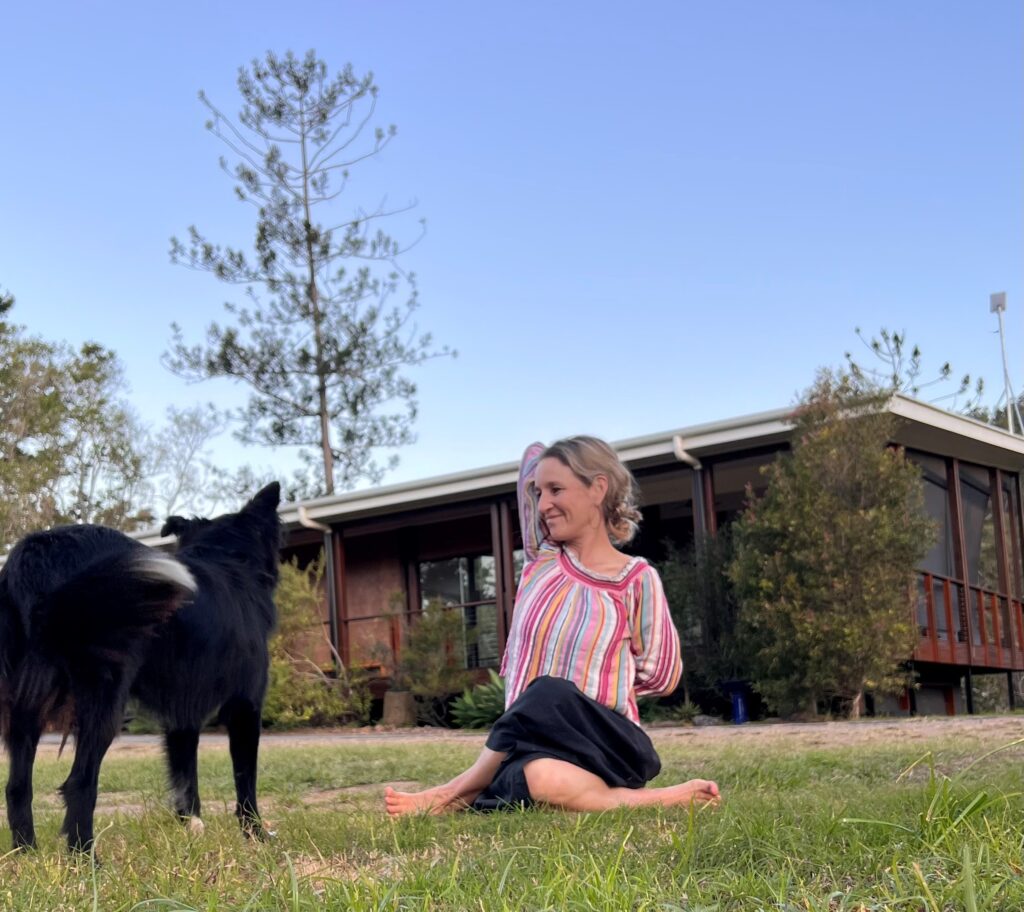
Derived from the word go = cow, mukha = face and asana = pose. Thus, Gomukhasana means “Cow Face Pose”.
How to perform Gomukhasana
1. Begin by sitting in Dandasana (staff pose), then bend your knees and place your feet on the ground. Bring your left foot to the outside of your right hip, under the right knee. Then cross your right leg over your left, placing your right knee on top of your left knee, and put your right foot on the outside of your left thigh. Try to keep your heels equidistant from your hips by pulling your right heel closer to your left hip and placing your right foot on top. Sit gently on your sitting bones.
2. While inhaling, extend your right arm straight to the right side, keeping it parallel to the floor. Turn your hand inward; the thumb first turns to the ground, then it should point to the wall behind you, and the palm should be directed to the ceiling. With this movement, your right shoulder will roll slightly upwards and forwards, and your upper back will become rounded. Exhale fully and sweep your arm behind your body and place the forearm in the hollow of your lower back, keeping it parallel to your waist with the right elbow placed against the right side of your body. Bring the shoulder backwards and downwards, and then take your forearm up to your back until it lies parallel to your spine. The back of the hand will be between the shoulder blades. Ensure that your right elbow does not move away from the right side of the body.
3. Inhale and lengthen your left arm straight in the forward direction, facing towards the opposite wall, lying parallel to the ground. Raise your palm and extend your arm straight up to the ceiling, palms turned back during the next breath. Actively pull up through your left arm, and then bend your elbow and move down to the right hand during exhalation. If possible, have the fingers of each hand hook onto each other. Pull the left elbow up towards the ceiling and pull the right elbow toward the ground from the back armpit. Your shoulder blades should be placed firmly against your back ribs, and you should pull your chest up. Try to keep your left hand next to the left side of your head.
4. Hold this pose for 60 seconds. Afterwards, release the arms and legs. Repeat the pose with opposite arms and legs for the same time. Remember that the leg on top and the arm on the bottom will be on the same side.
Gomukhasana Benefits
Western Physiology
Gomukhasana has a therapeutic effect on physical health.
- Gomukhasana stretches and strengthens the muscles:
- It helps stretch the ankles, thighs, hips, armpits, shoulders, triceps and muscles of the chest.
- It helps cure cramps in the legs and increases the leg muscles’ elasticity.
- It helps expand the chest and straighten the back.
- This pose, amongst others, helps improve flexibility and range of motion (Choudhary & Patlong, 2020; G. Kalpana & Department, 2020; Grabara & Szopa, 2015).
- This pose, amongst others, helps alleviate shoulder and arm pain amongst breast cancer patients (Eyigor et al., 2018).
- This pose, amongst others, improves muscular strength and cardiorespiratory endurance (Choudhary & Patlong, 2020).
- Other therapeutic effects of Gomukhasana include but are not limited to:
- This pose improves scapular posturing and positively affects people with hyperkyphosis (Wang et al. 2012).
- This pose benefits those with asthma (Agnihotri et al., 2016, 2017; Jasrotia et al., 2019).
- This pose, amongst others, is recommended as a complementary therapy for people with diabetes (Sharma & Gupta, 2014).
- This pose helps treat piles (haemorrhoids) (Mahesh Raju et al., 2017).
- This pose, in tandem with others, improves blood pressure and central obesity (Siu et al., 2015).
Yogic Physiology
- Gomukhasana opens the chest, heart and lungs. It is an excellent pose for removing avalambhaka kapha, congestion or build up on these sensitive kapha prone areas.
- The posture opens the chest physically and emotionally, namely the heart space, anahata akash. It aligns the head over the heart and therefore the flow of prana along chitta nadi, which will energise the mind.
- It affects the four lohitaksha marma points that correspond directly with lymph nodes under the arms and deep in the hips.
- The action in the upper and lower limbs will promote blood circulation, the flow of lymph and affect vyana vayu.
Chinese Medicine
This posture will affect the heart meridian lines – running from armpits to little fingers. The flow of Qi will also take effect on the side of the legs, the gall bladder meridian lines. The central meridian along the front line of the body will also be opened by this pose.
Contradictions and Cautions
Individuals suffering from severe knee, neck or shoulder problems should not perform this pose.
Preparatory Asanas
- Baddha Konasana
- Supta Virasana
- Supta Baddha Konasana
- Supta Padangusthasana
- Upavistha Konasana
- Virasana
Follow up Asanas
- Ardha Matsyendrasana
- Bharadvajasana
- Garudasana
- Marichyasana III
- Padmasana
- Paschimottanasana
- Upavistha Konasana
Tips for Beginners
Beginners often have difficulty getting both sitting bones to rest evenly on the floor, which can make it difficult for the knees to stack on top of each other evenly. When the pelvis is tilted, the spine can’t correctly extend. If this is the case, use a folded blanket, block or the narrow edge of a bolster to lift the sitting bones off the floor and support them evenly.
Variations
From the full pose, lean forward and lay the front torso down on the inner top thigh. Stay for 20 seconds, then inhale gently and come up.
Modifications and Props
Gomukhasana (Cow Face Pose) is quite a challenging pose to perform for individuals who have tight shoulders and who are unable to hook their fingers together. A simple solution to this problem exists: holding a strap between the hands. You should start the pose with a strap placed over the shoulder of the bottom arm. In the second step, when you move the bottom arm behind your back, bring the forearm as high as possible on the back of the body and hold the bottom end of the strap. In the third step, lengthen the arm over your head, move down the back, and hold the other end of the yoga strap. Pull the strap with the top arm. Try to move the bottom arm higher on the back.
Deepen the Asana
You can increase the stretch in this pose if you’re a little more flexible in the shoulders and armpits by moving your hands away from the back of your torso. You could try and hold a belt with a 10 cm gap between your hands and lift the belt away from the back, which makes the posture on the arms quite challenging.
References
Choudhary, V., & Patlong, I. (2020). A Study on Pre- and Post-Competitive State Anxiety among the Athletes. In International Conference on Enhancing Skills in Physical Education and Sport Science (pp. 369–371).
Kalpana, & Department. (2020). Effects of 4-Week Yoga Training on Muscular Strength, Muscular Endurance, Flexibility, and Agility of Female Hockey Players. International Conference on Enhancing Skills in Physical Education and Sport Science, 635–637.
Grabara, M., & Szopa, J. (2015). Effects of hatha yoga exercises on spine flexibility in women over 50 years old. Journal of Physical Therapy Science, 27(2), 361–365. https://doi.org/10.1589/jpts.27.361
Eyigor, S., Uslu, R., Apaydın, S., Caramat, I., & Yesil, H. (2018). Can yoga have any effect on shoulder and arm pain and quality of life in patients with breast cancer? A randomized, controlled, single-blind trial. Complementary Therapies in Clinical Practice, 32, 40–45. https://doi.org/10.1016/j.ctcp.2018.04.010
Wang, M. Y., Greendale, G. A., Kazadi, L., & Salem, G. J. (2012). Yoga Improves Upper-Extremity Function and Scapular Posturing in Persons with Hyperkyphosis. Journal of yoga & physical therapy, 2(3), 117. https://doi.org/10.4172/2157-7595.1000117
Agnihotri, S., Kant, S., Mishra, S. K., & Singh, R. (2016). Efficacy of yoga in mild to moderate persistent chronic bronchial asthma. Indian Journal of Traditional Knowledge, 15(2), 337–340.
Agnihotri, S., Kant, S., Mishra, S. K., & Singh, P. (2017). Role of yoga in childhood asthma. Indian Journal of Traditional Knowledge, 16(June), S21–S24.
Jasrotia, R., Mondal, S., Kumar, V., & Gandhi, A. (2019). Impact of adjunct treatment with yoga on severity, illness score, and drug dosage in controlled asthmatic children. National Journal of Physiology, Pharmacy and Pharmacology, 9(12), 1. https://doi.org/10.5455/njppp.2019.9.0930210092019
Sharma, N., & Gupta, N. (2014). Effect of yoga on glycemic profile in diabetics. International Journal of Medical Science and Public Health, 3(9), 1135. https://doi.org/10.5455/ijmsph.2014.020720141
Mahesh Raju B., Bargale Sushant Sukumar, T. B. Tripathy, & Rakshith KR. (2017). Management of Haemorrhoids (Arsha) with Yogic Life Style. Journal of Ayurveda and Integrated Medical Sciences, 2(05), 126-132. Retrieved from https://www.jaims.in/jaims/article/view/319
Siu, P. M., Yu, A. P., Benzie, I. F., & Woo, J. (2015). Effects of 1-year yoga on cardiovascular risk factors in middle-aged and older adults with metabolic syndrome: a randomized trial. Diabetology & metabolic syndrome, 7, 40. https://doi.org/10.1186/s13098-015-0034-3
If you would like to contact Celia to learn more about the meditation teacher training journey, please do visit our Meditation Teacher Training Page or find us on Facebook or Instagram or contact Celia directly.