
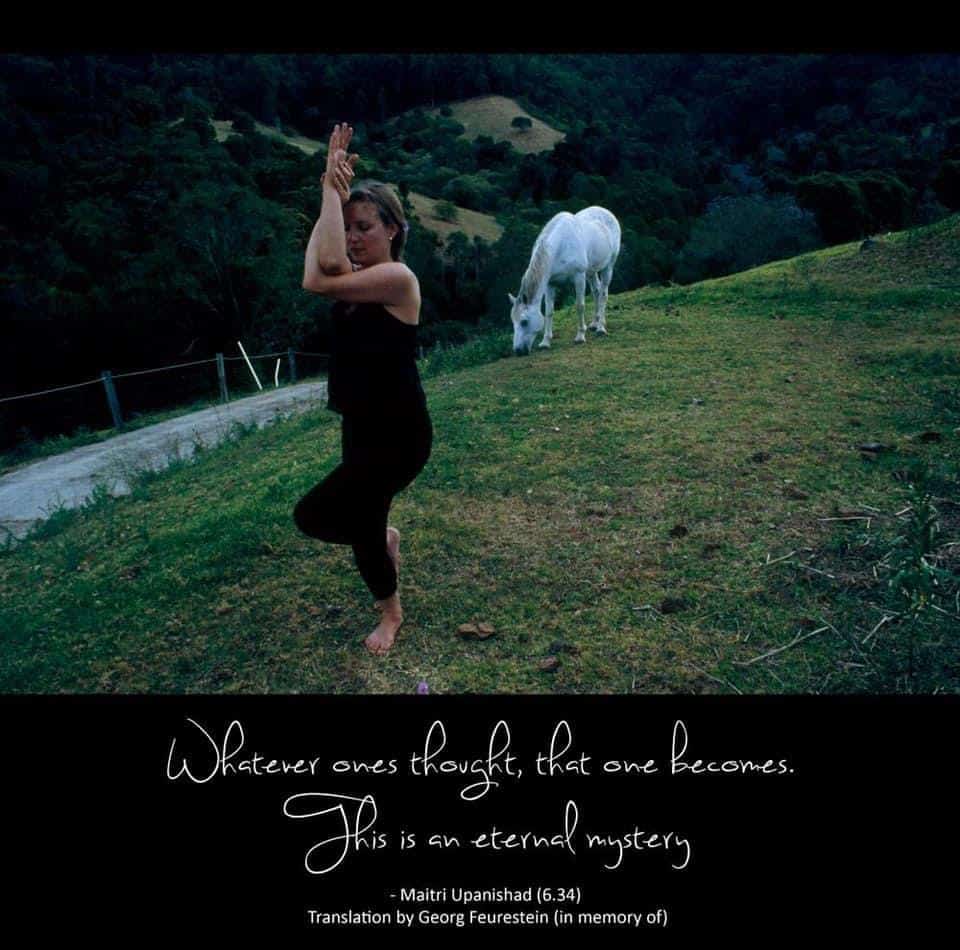
Derived from the word garuda = eagle, and asana = pose. Thus, Garudhasana means “Eagle Pose”.
How to perform Garudhasana
1. Begin by standing in the pose of Tadasana. Then, slightly bend your knees, pull up your left foot, and wrap your left thigh over the right thigh while maintaining balance on your right foot. Point your left toes toward the ground, push the foot back and hook the upper dorsal portion of the foot behind the lower part of the right calf. Maintain your balance on the right foot.
2. Lengthen your arms forward and bring them parallel to the earth. Stretch your scapulae across the posterior portion of your body. Place your right arm above the left, and then bend the elbows. Press your right elbow firmly into the crook of your left elbow while bending your forearms at a 90-degree angle to the floor. The back of your hands should face each other.
3. Push the right hand to the right side and the left to the left side so that the palms face each other. The thumb of your right hand should lie in front of the little finger of your left hand. Press the hands together with as much force as possible. Raise your elbows and lengthen your fingers towards the ceiling.
4. Stay in this pose for 15-30 seconds, then return to Tadasana. Repeat for the same duration after reversing the position of the arms and legs.
Garudhasana Benefits
Western Physiology
Garudasana has a therapeutic effect on mental and physical health.
- Garudasana improves mental health:
- This pose, amongst others, can relieve stress and state anxiety levels (Erdoğan Yüce & Muz, 2020).
- Garudasana stretches and strengthens the muscles:
- It helps in stretching and strengthening the ankles and calves (Kanjirathingal et al., 2021).
- It helps in relieving tension in the arms, shoulders, neck and upper back (White, 2001).
- It helps strengthen the arms and legs (Akademia & Fizycznego, 2016).
- It helps reduce inflammation and strengthen the pectoral muscle, which in turn aids in the prevention and easy treatment of frozen shoulder (Jadhav et al., 2022).
- It helps in preventing cramps from the calf muscles.
- Other therapeutic effects of Garudhasana include but are not limited to:
- It helps in improving concentration.
- It is helpful during pregnancy in alleviating upper back pain (White, 2001).
- It provides therapeutic benefits for asthma, sciatica, and low back pain.
- Improve posture and balance of the spine (Akademia & Fizycznego, 2016).
- In combination with other standing poses, it increases self-esteem and a sense of energy (Golec de Zavala et al., 2017).
Yogic Physiology
- This posture squeezes and pushes the lohitaksha marma points in armpits and hips – which aids the lymphatic system.
- It balances the flow between prana vayu and udana vayu.
- It assist is developing the concentration and focus in the third eye – ajna chakra.
- It assists in developing strength in the base of the body – muladhara chakra.
Chinese Medicine
The posture affects all the meridians of the arms and of the legs. Examples below:
- Arms: heart, small intestine
- Legs: liver and gallbladder
Contradictions and Cautions
You may choose to avoid this pose if you are suffering from a knee injury.
Preparatory Asanas
- Adho Mukha Svanasana
- Gomukhasana
- Prasarita Padottanasana
- Supta Virasana
- Supta Baddha Konasana
- Upavistha Konasana
- Virasana
- Vrksasana
Follow up Asanas
Garudhasana is usually performed towards the end of a series of standing poses. The position of the arms in this pose is especially useful for teaching how to expand the back of the torso in inverted poses such as Adho Mukha Vrksasana and Sirsasana. Other follow-up poses might include:
- Gomukhasana
- Utkatasana
- Vrksasana
Tips for Beginners
Beginners often find it challenging to wrap their arms around until the palms touch. If so, stretch your arms straight forward, parallel to the floor, while holding onto the ends of a strap. Follow the rest of the instructions stated in step 2 above and keep the strap taut between your hands. Beginners also find it difficult to hook the raised-leg foot behind the standing-leg calf and then balance on the standing foot. A short-term option is to cross the legs, but instead of hooking the raised foot and calf, press the big toe of the raised-leg foot against the floor to help maintain your balance.
Variations
Here’s a challenging variation of Garudhasana. From the pose described above, exhale and lean your torso into a forward bend, pressing the forearms against the top-leg thigh. Hold for a few breaths, then come up with an inhalation. Repeat on the second side.
Modifications and Props
Beginners usually find the balance in this posture very unstable. As with other standing balance poses, you can use the wall to prop up and support your back as you learn to balance. For the foot that is not in contact with the ground, you could choose to place that to a brick.
Deepen the Asana
Look at the tips of your thumbs once you are in the full pose. Typically, the thumb tips point a little bit off to the side of the upper arm. Press the mound of the upper thumb into the bottom hand and turn the thumb tips, so they point directly at the tip of the nose.
Stand on a bolster or brick to intensify the balance on the one leg.
Stretch the arms outwards towards the front of your mat to increase the stretch of the arms.
References
Erdoğan Yüce, G., & Muz, G. (2020). Effect of yoga-based physical activity on perceived stress, anxiety, and quality of life in young adults. Perspectives in Psychiatric Care, 56(3), 697–704. https://doi.org/10.1111/ppc.12484
Kanjirathingal, J. P., Mullerpatan, R. P., Nehete, G., & Raghuram, N. (2021). Effect of Yogasana Intervention on Standing Balance Performance among People with Diabetic Peripheral Neuropathy: A Pilot Study. International journal of yoga, 14(1), 60–70. https://doi.org/10.4103/ijoy.IJOY_75_20
White, M. (2001). Yoga for pregnancy – ProQuest. https://search.proquest.com/docview/212862471?pq-origsite=gscholar&fromopenview=true
Akademia, G., & Fizycznego, W. (2016). Hatha Yoga Exercises in Prevention and Correction of Body Posture Defects At. April.
Golec de Zavala, A., Lantos, D., & Bowden, D. (2017). Yoga Poses Increase Subjective Energy and State Self-Esteem in Comparison to ‘Power Poses’. Frontiers in psychology, 8, 752. https://doi.org/10.3389/fpsyg.2017.00752
Jadhav P., Thakur Vajrapratap S., Study of anatomical effects of Yogasana in Frozen Shoulder. J Ayu Int Med Sci. 2022;7(1):226-229.Available From https://jaims.in/jaims/article/view/1705
If you would like to contact Celia to learn more about the meditation teacher training journey, please do visit our Meditation Teacher Training Page or find us on Facebook or Instagram or contact Celia directly.