
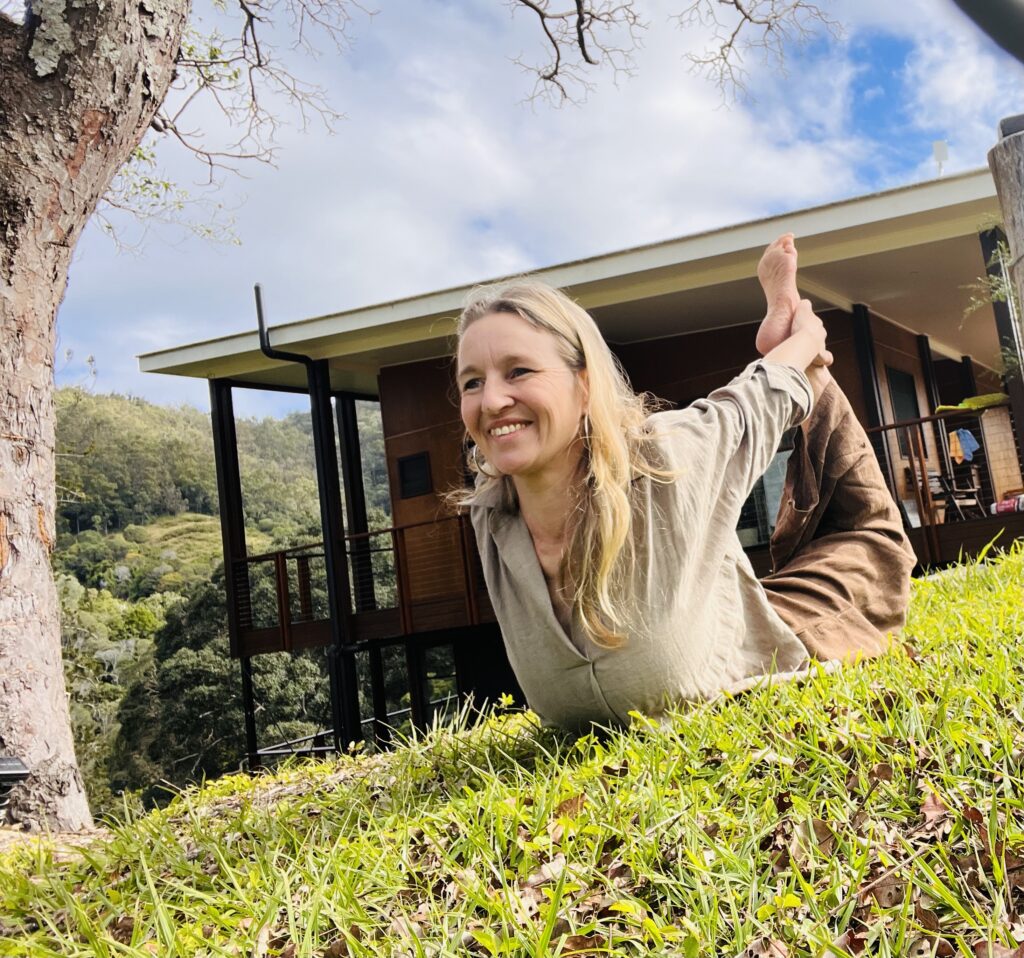
Derived from the word dhanu = bow, and asana = pose. Thus, Dhanurasana means “Bow Pose”.
How to perform Dhanurasana
1. Lie down on your belly in the prone position. Your hands may lie at your sides with palms up. During exhalation, bend your knees and bring your heels as close as possible to your buttocks. Then, bring your hands to your ankles and hold them. Avoid holding the top of your feet. Keep your knees at hip distance apart during the duration of the pose.
2. As you inhale, uplift your heels strongly away from your buttocks and, simultaneously, pull your thighs up and off the floor. This will also cause you to gently draw your upper body and head off the floor. Let your tailbone draw upwards while softening your back muscles. As you lift your body from the ground, press your shoulder blades against your back and lift your collar bones upwards and to the sky. The latter will open the heart and chest cavity. Bring the top of your shoulders away from your ears, and keep your gaze focused forward.
3. Breathing becomes slightly more difficult while the belly is pressed toward the ground. Therefore, one should breathe more gently into the back of the body. Ensure continuous slow and long breathing throughout the pose.
4. Hold this pose for at least 20-30 seconds. Exhale on the release of the pose. Lie quietly on the ground for a few breaths afterwards. Repeat the pose 1-2 more times.
Dhanurasana Benefits
Western Physiology
Dhanurasana has a therapeutic effect on mental and physical health.
- Dhanurasana improves mental health:
- It is helpful in relieving anxiety (Cowen & Adams, 2005).
- Dhanurasana benefits metabolism:
- It helps in relieving constipation (Dr Somlata Jadoun | Dr Akanksha Rana | Dr Sunil Kumar Yadav, 2020).
- This pose, along with Ardha Matsyendrasana, Bhastrika Pranayama, Bhujangasana, Padmasana, Paschimottanasana, Pawanmuktasana, Surya Namaskar, Shavasana. Sukhasana, Tadasana, Trikonasana, and Vajrasana reduce the blood glucose level and improves fat redistribution in among patients with type II diabetes (Malhotra et al., 2005).
- Dhanurasana is good for your spine:
- This pose, along with Salabhasana, helps people suffering from slipped discs (Dr Somlata Jadoun | Dr Akanksha Rana | Dr Sunil Kumar Yadav, 2020).
- This pose, performed with others, helps improve spine flexibility (Grabara & Szopa, 2015).
- It has therapeutic benefits in mild back pain (Rakhshaee, 2011).
- Dhanurasana stretches and strengthens the muscles:
- Helps stretch the chest, abdomen, throat, hip flexors, and thighs (Dr Somlata Jadoun | Dr Akanksha Rana | Dr Sunil Kumar Yadav, 2020).
- It helps in strengthening the muscles of the back and improving posture.
- Other therapeutic effects of Dhanurasana include but are not limited to:
- It helps stimulate the organs in the neck and abdominal region (Dr Somlata Jadoun | Dr Akanksha Rana | Dr Sunil Kumar Yadav, 2020).
- This pose, performed with others, helps improve blood pressure (Cowen & Adams, 2005).
- It has therapeutic benefits in menstrual discomfort (Rakhshaee, 2011), fatigue, and respiratory ailments.
- This posture straightens the back, thereby improving breathing processes, leading to the free passage of air via the nasal passages. This explains the positive effect on snoring and sleep apnea (Kumar et al., 2019).
Yogic Physiology
- This posture puts pressure on the basti (bladder) marma point and nabhi (navel) marma point. This pressure is said to affect the flow of prana to these respective organs and energetic centres.
- The pose opens up the east side or front of the body and the KUM region of the body at the level of the diaphragm, which is said to reduce dukkha (suffering) and increase sukka (ease).
- It opens anahata akash (the heart space).
- It elevates and uplifts the mind (manovaha srota).
- It regulates pitta and regulates samana vayu, stimulating agni.
- It reduces vata in the colon, and improves circulation in the digestive region overall.
- It is said to stimulate kundalini to a degree through the central channel: sushumna.
Chinese Medicine
The posture affects the two main meridians: the Ren (Conception) and the Du (Governing), which run down the centre of the body. It also affects the spleen and stomach meridian lines, which run along the front of the body.
Contradictions and Cautions
Individuals suffering from high or low blood pressure, migraines, insomnia, and severe lower back (Plastaras et al., 2015) or neck injury should avoid this pose.
Preparatory Asanas
- Bhujangasana
- Salabhasana
- Setu Bandha Sarvangasana
- Supta Virasana
- Urdhva Mukha Svanasana
- Virasana
Follow up Asanas
- Matsyasana
- Setu Bandha Sarvangasana
- Urdhva Mukha Svanasana
- Ustrasana
Tips for Beginners
Sometimes beginners find it difficult to lift their thighs from the floor. If this is the case, you can give your legs a little upward boost by lying with your thighs supported on a rolled-up blanket.
Variations
A variation of Dhanurasana is called Parsva (parsva = side, flank) Dhanurasana. To perform this Dhanurasana variation, follow the main instructions above. Then with an exhalation, dip your right shoulder toward the floor, firmly tug your left foot to the right, and roll over onto your right side. Students often have difficulty rolling over for the first time. If this is the case, do not despair. You may roll to your side without holding onto your ankles. Just bend your knees and use your hands to help you get a feel for the rolling movement. Stay on your right side for 20-30 seconds. Then, as you exhale, roll across your belly and over to the left side. Stay here for the same duration, then finally roll back onto your belly with an exhale. Parsva Dhanurasana gives an excellent massage to your abdominal organs.
Modifications and Props
If more comfortable, feel free to lay prone on a blanket for padding. If you can’t hold onto your ankles directly, wrap a strap around the fronts of your ankles and hold the free ends of the strap with your hands. If you choose to do this, ensure your arms are fully extended.
Deepen the Asana
You can increase the challenge of this pose by having your thighs, calves, and inner feet touching or place a long vertical bolster under the front of your body and lift yourself on that, which makes it harder to balance and for some people, a little more fun!
References
Cowen, V. S., & Adams, T. B. (2005). Physical and perceptual benefits of yoga asana practice: Results of a pilot study. Journal of Bodywork and Movement Therapies, 9(3), 211–219. https://doi.org/10.1016/j.jbmt.2004.08.001
Dr. Somlata Jadoun | Dr. Akanksha Rana | Dr. Sunil Kumar Yadav. (2020). An Anatomical Exploration of “Dhanurasana”. International Journal of Trend in Scientific Research and Development, 4(4), 5–11. https://www.ijtsrd.com/papers/ijtsrd30878.pdf%0Ahttps://www.ijtsrd.com/medicine/other/30878/an-anatomical-exploration-of-“dhanurasana”/dr-somlata-jadoun
Malhotra V, Singh S, Tandon OP, Sharma SB. The beneficial effect of yoga in diabetes. Nepal Medical College Journal : NMCJ. 2005 Dec;7(2):145-147. PMID: 16519085.
Grabara, M., & Szopa, J. (2015). Effects of hatha yoga exercises on spine flexibility in women over 50 years old. Journal of Physical Therapy Science, 27(2), 361–365. https://doi.org/10.1589/jpts.27.361
Rakhshaee, Z. (2011). Effect of Three Yoga Poses (Cobra, Cat and Fish Poses) in Women with Primary Dysmenorrhea: A Randomized Clinical Trial. Journal of Pediatric and Adolescent Gynecology, 24(4), 192–196. https://doi.org/10.1016/j.jpag.2011.01.059
Kumar, V., Malhotra, V., & Kumar, S. (2019). Application of Standardised Yoga Protocols as the Basis of Physiotherapy Recommendation in Treatment of Sleep Apneas: Moving Beyond Pranayamas. Indian journal of otolaryngology and head and neck surgery : official publication of the Association of Otolaryngologists of India, 71(Suppl 1), 558–565. https://doi.org/10.1007/s12070-018-1405-5
If you would like to contact Celia to learn more about the meditation teacher training journey, please do visit our Meditation Teacher Training Page or find us on Facebook or Instagram or contact Celia directly.