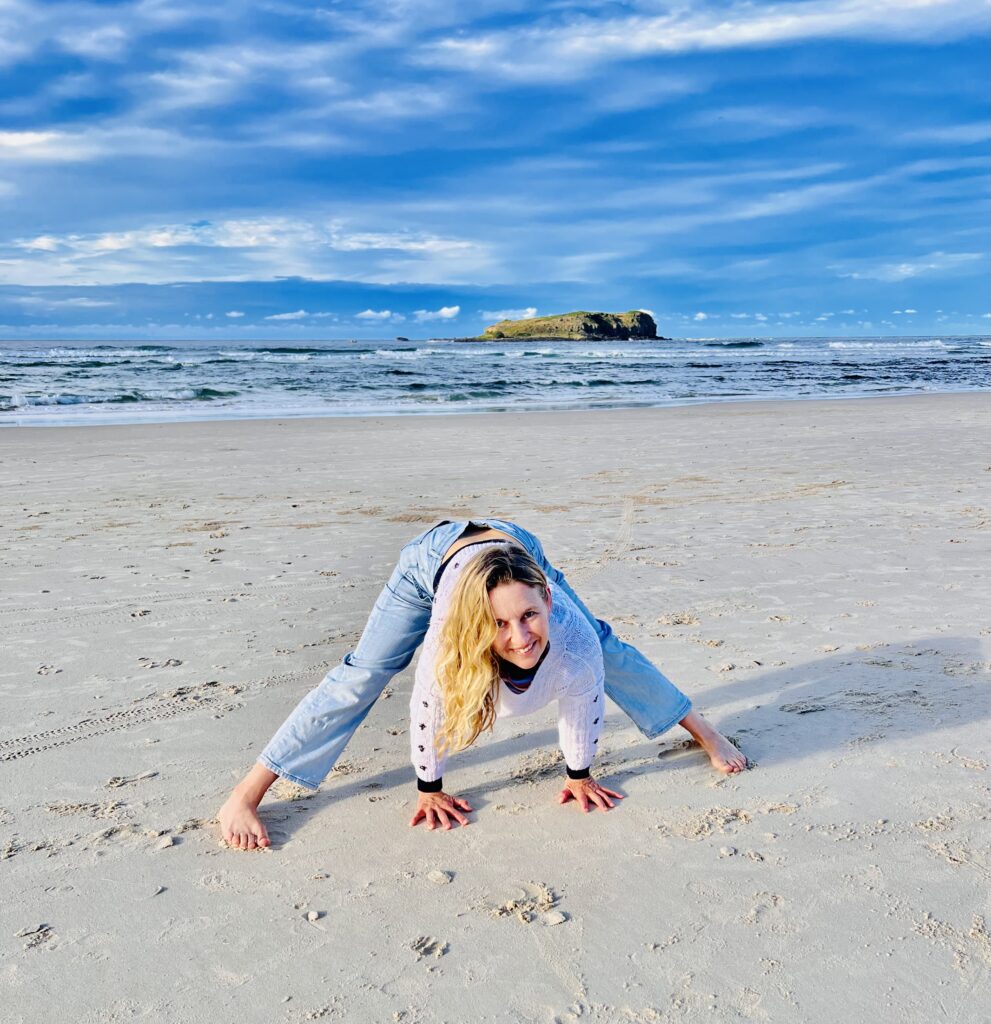
The meaning of Prasarita is spread, extended or expanded. Pada refers to a foot. This is a pose in which the legs are expanded and stretched intensely.
How to perform Prasarita Padottanasana
1. Stand in the pose of Tadasana; face one of the long edges of your yoga mat, then lightly step or jump to stand at a distance of 1m-1.5meters apart depending on how tall you are: taller people should step wider. Keep your hands on your hips. Ensure that the inner sides of your feet are placed parallel to each other. Lift the inner sides of arches by lifting the inner ankles and pressing the outer edges and ball of the big toe firmly into the ground. The pressing of the big toe will stop hyperextension at the back of the knee according to Iyengar Yoga. Draw the thigh muscles up and engage them. Inhale and pull up your chest, making the front portion slightly longer than the back portion of the body.
2. Exhale and tilt your upper body forward from your hips, trying to keep the length of the front of your body. Once the body is parallel to the floor, place your fingertips on the ground below your shoulders, keeping your elbows fully extended. In this position, your legs and arms should be perpendicular to the ground and parallel to each other. Take your spine evenly into the back portion of the body such that your back becomes slightly concave, starting from the tailbone to the base of the skull. Take your head up, keep the back of the neck stretched and keep your gaze focused upward to the ceiling actively stretching the ocular muscles.
3. Push the top of your thighs back to aid in stretching the front part of the body and take the inner groins away from each other so that the base of your pelvis is widened. Take a couple of breaths. While you maintain the back in a concave position and your sternum and chest lifted forward, move your fingertips between your feet. Take a couple more breaths, and then exhale, bend your elbows and lower your body and head into a forward bend (full). Take care to keep the front portion and side waists of your body as long as possible while you are moving down. If it is possible for you, touch the crown of your head to the ground.
4. Actively press your inner palms into the ground, with fingers pointing in the forward direction. If you are flexible enough, move your body into a full forward bend and move your hands back till your forearms lay perpendicular to the ground and your upper arms parallel. Keep your arms parallel to each other and stretch the shoulder blades across the back. Move your shoulders away from your ears.
5. Hold in this pose from 30 seconds to 60 seconds. Return by placing your hands on the floor below your shoulders and pulling up and stretching your front body. Inhale and keep your hands on your hips, press your tailbone down to the ground and bring the upper body up. Return to the Tadasana pose.
Prasarita Padottanasana Benefits
Western Physiology
Prasarita Padottanasana has a therapeutic effect on mental and physical health.
- Prasarita Padottanasana improves mental health:
- This pose, in tandem with others, improves the mood and perception of stress (Innes & Selfe, 2012).
- It helps in relieving symptoms of mild depression (Innes & Selfe, 2012).
- Other therapeutic effects of Prasarita Padottanasana include but are not limited to:
- It helps stretch and strengthen the inner and back legs and spine.
- This pose, in tandem with others, reduces blood pressure (Innes & Selfe, 2012).
- It helps in toning the abdominal organs.
- It helps in relieving low back pain (Williams et al., 2009).
- This pose, in tandem with others, helps in relieving fatigue and headache (Anheyer et al., 2020).
- This pose, in tandem with others, improves the quality of life as well as sexual function (Huang et al., 2017).
- This pose, in tandem with others, increases cardiovascular endurance (Lau et al., 2015).
- This pose, in tandem with others, improves the symptoms of Irritable Bowel Syndrome (Evans et al., 2014).
Yogic Physiology
This posture works apana vayu and vyana vayu. It works the sacral and base chakras. In Ayurveda, the pose is particularly beneficial for pacifying vata and pitta and less so for kapha.
Chinese Medicine
It works the liver meridian on the inside of legs and the bladder and kidney meridians on the back body.
Contradictions and Cautions
- If you suffer from lower back problems, you should avoid the full forward bend.
Preparatory Asanas
This pose is usually performed towards the end of the standing pose practice. In addition to many standing poses, good preparation for this pose are:
- Adho Mukha Svanasana
- Supta Baddha Konasana
- Uttanasana
Follow up Asanas
- Baddha Konasana
- Bakasana
- Paschimottanasana
- Sirsasana
- Utthita Parsvakonasana
Tips for Beginners
Most beginners cannot easily rest the crown of their head on the ground in the last stage of this asana. Instead, you can rest your head on a padded block, a bolster or a thickly folded blanket.
Variations
The posture mentioned here is Prasarita Padottanasana I (according to the Ashtanga systems). Prasarita Padottanasana II is a more difficult variation.
Follow the first step of the main guide above. Then place your hands in back in Anjali Mudra, a hand position sometimes called Pristanjali Mudra (prish-TOHN-jolly; prishta = “the back, the rear of anything”), or sometimes Paschima Namaskar (posh-EE-mah nam-AHS-car; paschima = “west”; namaskar = “to greet or salute”). To do this, tilt your torso slightly forward and round your back. Then squeeze your palms together behind your back, placing your thumbs on your sacrum and the rest of your fingers pointing towards the ground. Exhale and turn your fingers first to your back, then up so that they point towards the ceiling. Raise your little fingers on your back as high as possible, ideally between your shoulder blades. Try to push your shoulders back and lift your chest, pressing your pinkies deep into your spine. Finally, exhale in a forward bend and lower your head to the ground. If this arm position is not possible, simply cross your forearms behind your back and hold your elbows with opposite hands.
Modifications and Props
Some beginners cannot bring their hands to the ground, and they need a great deal of support to do this forward bend to protect their lower back from injury. You can try raising your hands off the ground and rest each of them on a block. A folding chair can also be used to provide support to your forearms. You should always emphasize the importance of the length of the front torso in forwarding bends.
Deepen the Asana
Advanced practitioners can better understand how to work their arms in this asana using a block. Lay the block on one side, so its long axis is parallel to the long edge of your sticky rug on the floor in front of you. Lean forward into the posture, placing the block between your forearms, just below your elbows, and lift it off the ground. Afterwards, complete the pose with your palms and crown on the ground. Now firmly squeeze the block between your forearms, actively pressing your palms to the floor. This arm movement will also prepare you for postures such as headstand variations and Pincha Mayurasana (peacock pose).
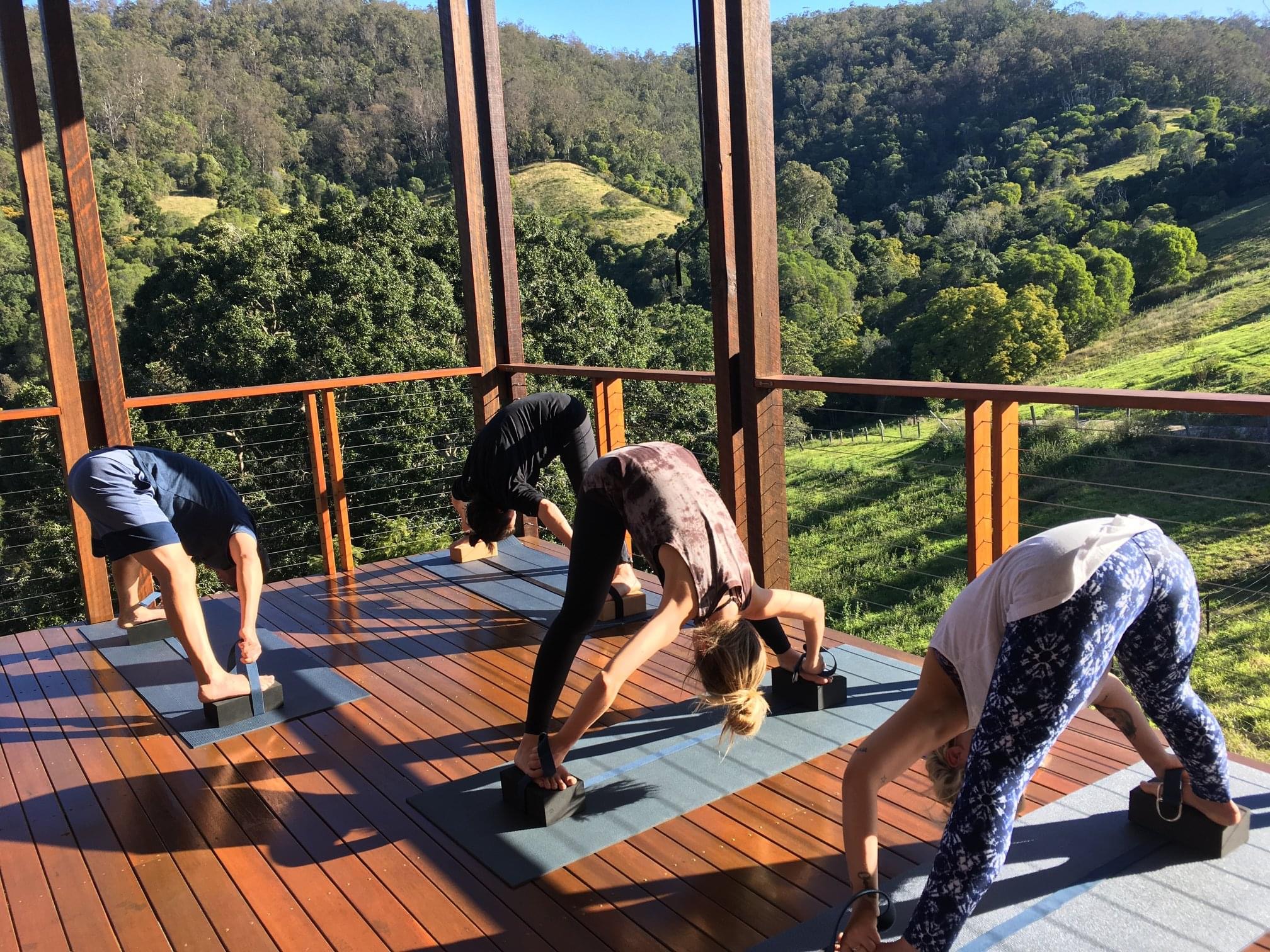
To challenge the balance and further stretch the hamstrings, place the feet on two blocks with a belt underneath both bricks. Bring the arms to hold both the sides of the belts and tilt the sit bones over the heels a little further to challenge your balance on the bricks.
References
Innes KE, Selfe TK. The Effects of a Gentle Yoga Program on Sleep, Mood, and Blood Pressure in Older Women with Restless Legs Syndrome (RLS): A Preliminary Randomized Controlled Trial. Evid Based Complement Alternat Med. 2012;2012:294058. doi: 10.1155/2012/294058.
Williams K, Abildso C, Steinberg L, Doyle E, Epstein B, Smith D, Hobbs G, Gross R, Kelley G, Cooper L. Evaluation of the effectiveness and efficacy of Iyengar yoga therapy on chronic low back pain. Spine (Phila Pa 1976). 2009 Sep 1;34(19):2066-76. doi: 10.1097/BRS.0b013e3181b315cc.
Huang AJ, Rowen TS, Abercrombie P, Subak LL, Schembri M, Plaut T, Chao MT. Development and Feasibility of a Group-Based Therapeutic Yoga Program for Women with Chronic Pelvic Pain. Pain Med. 2017 Oct 1;18(10):1864-1872. doi: 10.1093/pm/pnw306.
Anheyer D, Klose P, Lauche R, Saha FJ, Cramer H. Yoga for Treating Headaches: a Systematic Review and Meta-analysis. J Gen Intern Med. 2020 Mar;35(3):846-854. doi: 10.1007/s11606-019-05413-9.
Lau C, Yu R, Woo J. Effects of a 12-Week Hatha Yoga Intervention on Cardiorespiratory Endurance, Muscular Strength and Endurance, and Flexibility in Hong Kong Chinese Adults: A Controlled Clinical Trial. Evid Based Complement Alternat Med. 2015;2015:958727. doi: 10.1155/2015/958727.
Evans S, Lung KC, Seidman LC, Sternlieb B, Zeltzer LK, Tsao JC. Iyengar yoga for adolescents and young adults with irritable bowel syndrome. J Pediatr Gastroenterol Nutr. 2014 Aug;59(2):244-53. doi: 10.1097/MPG.0000000000000366.
If you would like to contact Celia to learn more about the meditation teacher training journey, please do visit our Meditation Teacher Training Page or find us on Facebook or Instagram or contact Celia directly.

