
The skin of the face, like any other organ, ages over time. But, unlike most organs, the skin is the primary indicator of age and health (Beri et al., 2013).
Nowadays, anti-aging or anti-wrinkle procedures are on the rise. Millions of dollars are spent on various surgical and non-surgical (like Botox and fillers) procedures to look young and beautiful. Sadly, botox changes our brain. Injections in the forehead and face are found to rearrange the brain’s sensory map of the hands (Haenzi et al., 2014). The map of the hands sit side by side to the cortical facial somatosensory map in the brain. And the more Botox you use, the bigger the negative effect. Research now shows the changes are not only limited to the maps of the hands, but that it has more widespread effects and unintended consequences within the nervous system (Hallett, 2018). Botox around the eyes also creates a freeze response to those facial muscles making us unable to mimic the finer microexpressions of another human being, changing the empathetic reaction pathway in the brain (Davis et al., 2010). In light of the above, yoga for the face is becoming more and more popular over time, both in combination with other procedures and singularly (Jakhar, 2018). In fact, the practice of yoga, a combination of physical and mental exercises, is consistent with the trend of “healthy ageing”, which is healthier and more natural than “anti-aging” (De Tollenaere et al., 2020).
In this article, we will go over the effects and underlying mechanisms of facial yoga. In addition, we will tell you which yoga exercises reduce facial skin ageing and how to perform them correctly. So, let’s dive in.
Facial skin structure and physiology
The skin is made up of three layers, namely the epidermis (the outer layer that is constantly regenerated), the dermis and the subcutaneous layer.
Numerous endogenous (metabolism, emotional stress, genetics and hormonal processes) and exogenous (exposure to sun, toxins, pollution, radiation, and chemicals) factors are involved in the complex process of skin ageing (Jakhar, 2018; De Tollenaere et al., 2020). The physiological process of skin ageing includes degeneration and deterioration of tissues and functions (Beri et al., 2013). Physiological processes leading to skin ageing occur mainly in the dermis, with a decrease and damage to its structural components, namely glycosaminoglycans, collagen and elastin (Beri et al., 2013; Jakhar, 2018). In addition, over the passage of time, skin loses its strength, antioxidant capacity, and proliferative functions (Beri et al., 2013). Facial ageing is also associated with the loss of muscle and fat tissue (Jakhar, 2018). In addition, glycosylation end products that accumulate in the skin as a result of various metabolic processes of oxidative stress also lead to skin ageing (Jakhar, 2018).
The Ayurvedic formula for healthy and youthful skin
According to Ayurveda, there are three main secrets to healthy and youthful skin (Datta et al., 2011):
- Adequate moisture balance (balanced Kapha)
- Coordinated metabolic mechanisms of the skin (balanced Pitta)
- Efficient blood circulation (balanced Vata)
Anti-aging procedures should be able to provide all these components to be considered effective. According to Ayurveda, yoga, as a disciplined science of life, is a natural preventive practice for good health and youthfulness (Datta et al., 2011).
Sun exposure and skin ageing
Sun exposure is a well-known risk factor for premature skin ageing. The ultraviolet rays directly affect the skin’s elastic fibres and facilitate the development of new wrinkles. In addition, according to the existing scientific evidence, sun exposure increases active cortisol levels in the skin, leading to slower wound healing and decreasing collagen production (De Tollenaere et al., 2020).
Yoga for Facial Skin
Though the information on the efficacy of face yoga is limited, its effects on skin-ageing factors, such as muscular activity, stress, oxidative processes, and metabolism, are well-established (Jakhar, 2018; De Tollenaere et al., 2020; Beri et al., 2013). Below we explain in detail the mechanisms underlying all these effects.
Facial yoga stimulates muscle growth
As stated above, ageing is associated with losing facial muscle mass and skin elasticity. Facial yoga stimulates facial muscle growth, visually improving the skin’s appearance. Moreover, increased muscle activity promotes the synthesis of collagen and elastin, structures that provide firmness, elasticity and youthfulness to the skin (Jakhar, 2018).
Facial yoga alters stress perception
The effect of yoga on stress perception is a well-known fact. Yoga decreases stress via down-regulation of the hypothalamic-pituitary-adrenal axis. Less stress equals fewer frowns and wrinkles (Jakhar, 2018). In addition, improving mental health increases the production of beta-endorphin and enkephalin, which improve skin homeostasis, local immune responses, and tissue repair (De Tollenaere et al., 2020).
Facial yoga has antioxidant effects
Yoga has an antioxidant effect on cells and tissues. The latter prevents the ageing of the skin, especially the one induced by excessive sun exposure (Beri et al., 2013).
Facial yoga improves metabolism
Facial yoga exercises mechanically stimulate facial tissues. This increases glucose utilisation and metabolism, which reduces glycosylation end products, the compounds promoting skin ageing (Jakhar, 2018).
Exercises that work against facial skin ageing
There is a set of face yoga exercises that was proven to be highly effective. According to the study conducted by Dr. Murad Alam and colleagues, just 30 minutes of daily facial exercises can lead to a youthful face in as little as 20 weeks (Alam et al., 2018).
Study participants completed 32 different exercises (Northwestern Magazine, 2018), including :
The Cheek Lifter
First, open your mouth in an “O” shape, cover your teeth with your upper lip, and smile; this will lift the cheek muscles. Then press your fingers on the top of your cheeks to push them down. Repeat lifting and lowering the cheeks ten times.
Video explanation:
Happy Cheeks Sculpting
Smile without your teeth, with your lips turned outward. While your lips are pursed, try to smile and lift your cheek muscles. Meanwhile, place your index fingers on the corners of the mouth. Then move them to the top of your cheeks and hold in this position for 20 seconds.
Video explanation:
Forehead Smoother
Place your fingertips over your eyebrows and press them down while trying to raise your eyebrows. Hold for 6 seconds, then relax and repeat 5 to 10 times.
Video explanation: https://www.happyfaceyoga.com/streaming/video08
Top Furrow Remover
Open your mouth in an “O” shape and cover your teeth with your upper lip. Put your index fingers at the nasolabial folds (“smile lines”) the way that you feel your cheekbones with the top of your index finger. Hold in this position for 30 seconds.
Video explanation: https://www.happyfaceyoga.com/streaming/video10
Scooping: Jaw and Neck firmer
Open your mouth and fold the lower lip and corners of the lips into your mouth and hold them firmly. Pushing the lower jaw forward, slowly scoop (using only the lower jaw) while closing your mouth. Imagine that you are scooping something very heavy with your jaw. With each sip, lift your chin an inch, slowly tilting your head back. Repeat opening and closing your mouth 10 times. In the end, your chin should be pointing towards the ceiling. Hold this position for 20 seconds. Repeat the sequence 3 times.
Video explanation: https://www.happyfaceyoga.com/streaming/video06
Option 2
Option 3
Other exercises that are known to be helpful in relaxing the mimic muscles, preventing wrinkles, and improving overall tissue oxygenation and metabolism (Ahmad, 2022) are below:
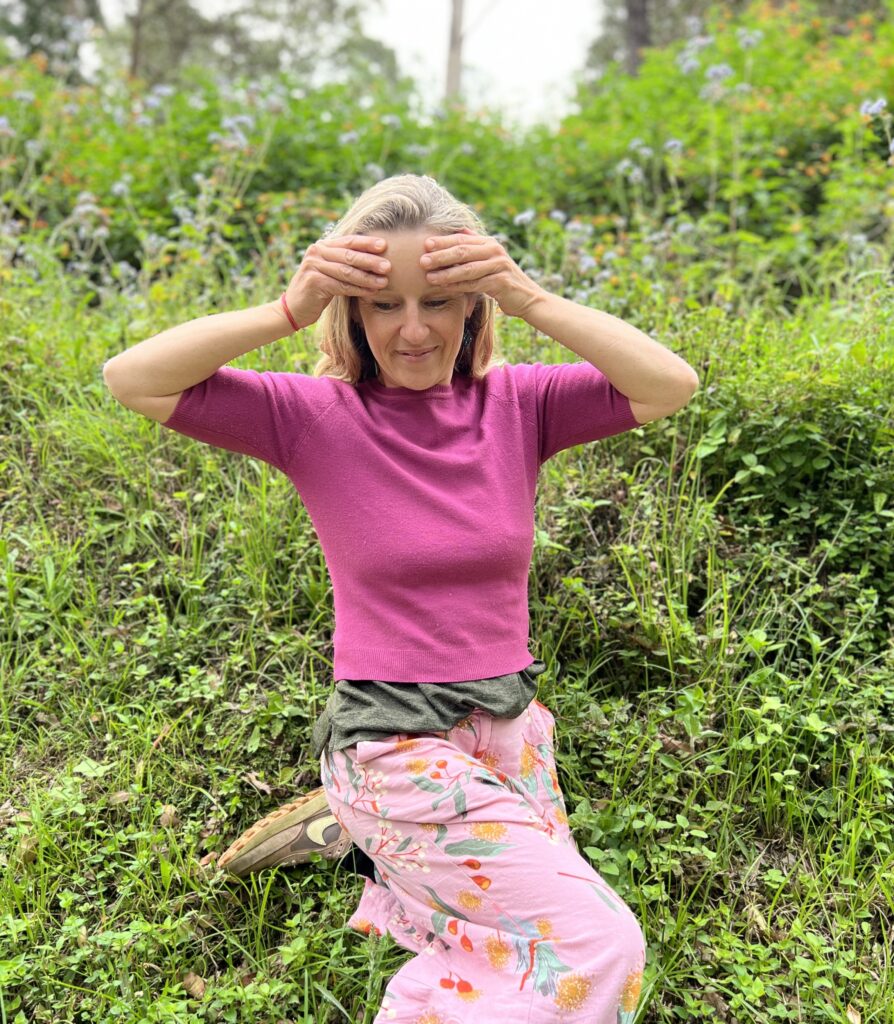
An exercise that helps to relax the frontalis muscle, a muscle that elevates the eyebrows
Place your fingertips in the middle of your forehead, facing inward. Move your fingers along the sides of your head while pressing down on your forehead. Continue for 30 seconds.
An exercise that helps to reduce the vertical wrinkles over the upper lip
Place your thumbs together under your upper lip. Push your lip forward with your thumbs while trying to press down on your thumbs with your upper lip. Hold for 6 seconds, then relax and repeat 5 to 10 times.
An exercise that makes the lips look full
Pull your lower lip forward to touch your upper lip. Then turn upper and lower lips inward while pressing them together (as if trying to hold something). Hold for 6 seconds, then relax and repeat 5 to 10 times.
References
Alam M, Walter AJ, Geisler A, et al. Association of Facial Exercise With the Appearance of Aging. JAMA Dermatol. 2018;154(3):365–367. doi:10.1001/jamadermatol.2017.5142
Beri K. Breathing to younger skin: ‘reversing the molecular mechanism of skin aging with yoga’. Future Sci OA. 2016 May 9;2(2):FSO122. doi: 10.4155/fsoa-2016-0015. PMID: 28031969; PMCID: PMC5137887.
Jakhar D. Face yoga: Preventive aesthetic dermatology. Res Clin Dermatol 2018 Volume 1 Issue 1. DOI:10.35841/CLINICAL-DERMATOLOGY.1.1.1
De Tollenaere M, Meunier M, Scandolera A, Sandre J, Lambert C, Chapuis E, Auriol D, Reynaud R. Well-aging: A new strategy for skin homeostasis under multi-stressed conditions. J Cosmet Dermatol. 2020 Feb;19(2):444-455. doi: 10.1111/jocd.13047. Epub 2019 Jun 24. PMID: 31232507; PMCID: PMC7003805.
Datta HS, Mitra SK, Paramesh R, Patwardhan B. Theories and management of aging: modern and Ayurvedic perspectives. Evid Based Complement Alternat Med. 2011;2011:528527. doi: 10.1093/ecam/nep005. Epub 2011 Jun 8. PMID: 19233879; PMCID: PMC3136561.
Davis JI, Senghas A, Brandt F, Ochsner KN. The effects of BOTOX injections on emotional experience. Emotion. 2010 Jun;10(3):433-40. doi: 10.1037/a0018690. PMID: 20515231; PMCID: PMC2880828.
Haenzi, S., Stefanics, G., Lanaras, T., Calcagni, M., & Ghosh, A. (2014). Botulinum Toxin-A dose dependent perceptual loss on the hand after its cosmetic use on the face. Cortex; a journal devoted to the study of the nervous system and behavior, 63, 118-120.
Hallett, M. (2018). Mechanism of action of botulinum neurotoxin: Unexpected consequences. Toxicon, 147, 73-76; Bertoni, M., Sakel, M., & Hojjatoleslami, A. (2018). Fractional Anisotropy Brain Changes in Spasticity after Peripheral Injections of Botulin. Int J Physiatry, 4, 015.
Facial Exercises Fight Appearance of Aging. Northwestern Magazine.
https://magazine.northwestern.edu/news/facial-exercises-fight-appearance-of-aging/. Published 2018. Accessed October 17, 2022.
AHMAD D. 7 yoga exercises for your face. tafakarr.. Published 2022.
If you would like to contact Celia to learn more about the meditation teacher training journey, please do visit our Meditation Teacher Training Page or find us on Facebook or Instagram or contact Celia directly.