
A Conversation with Dr David Frawley (Vāmadeva Śāstrī)
Interviewed by Celia Roberts
Introduction
Celia Roberts:
Welcome, Vāmadeva. Thank you so much. It is wonderful to speak with you again. Our topic today is Samādhi, and I would love for you to share your insights into its essence and practice.
Recently, I read the phrase “Yoga is Samādhi,” and it touched my heart deeply. I would love to hear your thoughts on this idea.
We were going to explore the different kinds of Samādhi, and how it can express through the guṇas: tāmasika, rājasic, and sāttvika. I remember reading in one of your books that even an alcoholic can experience a kind of absorption, because the mind becomes so focused, although it is not necessarily sāttvika but rather tāmasika. Could you help us understand that more clearly?
The Essence of Samādhi in Yoga
Dr David Frawley:
Namaste, Celia, and thank you for inviting me again. Samādhi is one of my favourite subjects, and it truly represents the essence of Yoga and the ultimate goal of human life, higher consciousness and Self-realization.
If we look back to the Yoga tradition, Patañjali defines Yoga as citta-vṛtti-nirodhaḥ, which means the stilling of the movements and distractions of the mind. That is essentially a definition of Samādhi and the commentators on the Yoga Sutras like that of Vedic Vyaasa state. Samadhi is the very inner nature of the mind (citta), the cit or pure consciousness behind citta or the agitated mind.
Samādhi can be understood more broadly as something the mind naturally seeks on all levels. It can include partial or lesser states of absorption as well as higher ones, whenever we move beyond the mind to some sort of merging of the mind into an object of perception, experience, sense of unity or simply forgetting the mind and its issues and turbulence, which we all seek in various ways.
In its deepest sense, Samādhi is the state in which the Puruṣa, the Seer, abides in its own nature as pure consciousness. Then the mind is like a mirror and reflects the Seer rather than the outer objects seen and their attractions and repulsions.—-Veda Vyaasa also states that Samadhi exists in all Chitta Bhoomis or states of mind, but can be tamasic, rajasic or sattvic as well as beyond the gunas.
The “5 chitta bhumis” are the five states of consciousness in yoga philosophy, which are Kshipta (distracted), Mudha (dull), Vikshipta (partially focused), Ekagra (one-pointed), and Niruddha (completely controlled). This model of the mind describes a progression from a scattered and turbulent state to one of profound stillness and self-awareness, a path illuminated by the practice of yoga. But at each level we can temporarily forget the mind, which is a kind of undeveloped Samadhi or absorption.
The term Citta refers to the mind in the widest sense. It includes memory, sensation, perception, knowledge, and reasoning. It also includes the conditioned or karmic mind, which expresses through dreaming, sleep, and waking thought.
The word nirodhaḥ can mean cessation, dissolution, return to the source, or simply non-identification as I am not the body or the mind. In other words, we are no longer identified with the activities of the mind. The mind can still function, but the yogi is not bound by it. Just as a yogi may perform āsana without being identified with the body, the same applies to the mind. This is the witness state, known as sākṣī-bhāva.
Samādhi and the Guṇas
Dr David Frawley:
We can look at Samādhi through the lens of the guṇas.
A tāmasika Samādhi may arise through dullness or inertia. It can occur in intoxication or deep sleep, where awareness becomes absorbed but is not present. We see this in various drug induced states of absorption like the use of opiates in which we forget ourselves, our minds and our sorrows.
A rājasic Samādhi arises from intense activity or passion. The mind is concentrated, but it is still restless and coloured by ego. The zone in running, or great achievements in life, fame and wealth can impart this to some degree.
Only when the Citta becomes sāttvika (pure, luminous, and tranquil) does true Samādhi begin to unfold. It is then that awareness shines in its own light, without distortion. Sattvic Citta gives us access to the Self beyond the gunas if we pursue a sadhana for it.
The mind’s main action is vikalpa which generally means imagination but also means projection or illusion. The mind is always imagining, projecting or getting caught in something. Except in deep sleep it does not rest in its own nature.
In Savikalpa Samādhi, the first stage of Samadhi, the meditator is still subtly aware of thought and form, trying to think or imagine that one is in a higher state of consciousness, imagining a higher and more subtle awareness. In other words one focuses on Samadhi and related yogic and Vedantic teachings and gets absorbed in these.
In Nirvikalpa Samādhi, all concepts,imaginations and projections of the mind dissolve and consciousness abides in itself as pure Being (Sat), pure awareness (Cit), and pure bliss (Ānanda). It is the unity of Ātman and Brahman, the Self realising itself in its own radiance. Nirvikalpa is the goal of Yoga and becomes Sahaja Samadhi or the natural state of Samadhi which is the natural state of Self-awareness. That is the ultimate goal of Yoga when the mind is transcended.
The Journey Through the Yoga Sūtras
Dr David Frawley:
The Yoga Sūtras unfold in four chapters, or pāda: Samādhi, Sādhana, Vibhūti, and Kaivalya.
The Samādhi Pāda gives the vision and background for Samadhi: Yoga is defined as the stilling of the mind or Samadhi. A few advanced Sadhakas can experience this directly as through meditation on Ishvara.
The Sādhana Pāda gives the methods to purify the mind to develop Samadhi for those who have not reached it: yama, niyama, āsana, prāṇāyāma, pratyāhāra, and then dhāraṇā, dhyāna, samādhi.
Patañjali also summarises Yoga practice as tapas, svādhyāya, īśvara-praṇidhāna, the Yoga of discipline, self-study, and surrender. Another direct path is devotion to Īśvara, approached through the sacred sound Oṃ.
The Vibhūti Pāda teaches saṃyama, the uniting of dhāraṇā, dhyāna, and samādhi. These are the states and powers of Samadhi as it develops. When this is mastered, higher knowledge and intuitive insight arise naturally.
The Kaivalya Pāda as the goal of Yoga and the full Samadhi, describes the state of complete liberation, where the Seer rests in its own nature, beyond all conditioning.
The Everyday Search for Absorption
Dr David Frawley:
Many people seek Samādhi without knowing it. Whenever we want to escape the mind (through intoxication, entertainment, or excitement) we are seeking a kind of absorption. Yet these are tāmasika or rājasic forms. They may bring temporary relief but do not last, and often create dependency.
As the mind is usually disturbed we all tend to seek some state of a calm, engaged or happy mind that may require external stimulation, distractions, sensations or even addictions.
True Samādhi arises when the mind becomes sāttvika, still, and one-pointed. This focused mind naturally expands into the silence of consciousness. When pure sattva is there the mind itself begins to dissolve.
Preparing the Mind and Heart
Dr David Frawley:
The two great virtues that prepare us for Samādhi are viveka (discernment) and vairāgya (detachment). We must learn to distinguish the eternal from the transient, the Self from what is not the Self. That is the essence of viveka.
Right living and an enlightened behavior and life-style is essential for this. The ethical observances of yama and niyama purify the mind. Their goal is to purify, calm and concentrate the mind. Satya as truthfulness, for example, is to help us develop a mind seeking and expressing truth.
Āsana steadies the body and releases tension and toxins, prāṇāyāma regulates the vital force and connects us to a higher prana, and dhyāna deepens concentration.
Even deep sleep gives us a glimpse of natural Samādhi, though without awareness. Through practice, we can remain conscious even in that silence.
Many Paths, One Goal
Dr David Frawley:
There are many paths that lead to Samādhi. In fact all of Yoga aims at that. Ātma-vichāra (Self-inquiry), bhakti (devotion), mantra-sādhana, prāṇāyāma, and rāja yoga all meet in the same silence and approach it from different angles.
The key is to make the mind one-pointed (ekagra). When thought focuses on a single reality, it transcends itself. Mantra is one of the most effective methods, because the sound of truth carries the mind beyond its own boundaries.
The Journey of Kuṇḍalinī and the Granthis
Celia Roberts:
Can you explain how Kuṇḍalinī Śakti and the granthis relate to Samādhi?
Dr David Frawley:
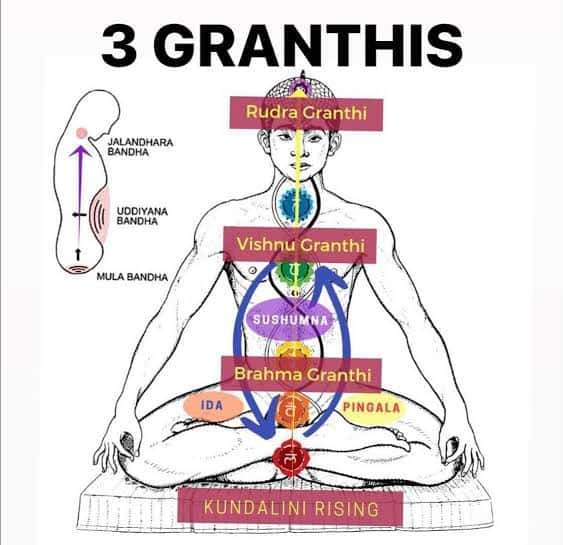
Yes. Agni, the fire of transformation, rises from the base of the spine, and Soma, the nectar of bliss, descends from above. As they meet within us, energy moves through the subtle centres, the cakras.
Along this journey are energetic knots, the granthis: Brahma-granthi, Viṣṇu-granthi, and Rudra-granthi. As these are opened, awareness becomes free to flow upward. The final opening is at the sahasrāra, the crown centre, through the brahma-randhra, leading to complete expansion in consciousness.
The Four Levels of Speech
Celia Roberts:
Could you describe the four levels of speech?
Dr David Frawley:
Yes. The four levels are vaikharī (spoken or ordinary), madhyamā (mental and emotional), paśyantī (visionary), and parā (transcendent, beyond words). In mantra practice, sound refines through these levels. It moves from audible words to subtle feeling, to vision, and finally to silence.
When the mantra becomes the mind’s single focus, it carries awareness beyond thought into the silence of Samādhi.
Devotion and Nonduality
Celia Roberts:
Is devotion to deities part of Māyā, or is it a way beyond it? Depends on the type of devotion. A higher devotion as in Bhakti Yoga is an inner surrender, a mere faith or believe based emotion can have rajasic and tamasic impurities
Dr David Frawley:
Devotion is essential to Yoga such as the emphasis on Ishvara Pranidhana in the Yoga Sutras. Note the following metaphor: The mind is like a wick, knowledge is the flame, and devotion is the oil that keeps it burning. Without devotion, the flame burns out quickly.
Bhakti, or loving surrender, softens and opens the mind, allowing the light of knowledge to shine. True devotion and true wisdom are not separate. The Self (Ātman) is both the worshipper and the worshipped.
Living Realisation
Celia Roberts:
Many people feel that Samādhi is beyond reach, but can it also be lived in everyday life? Samadhi is the essence of any direct awareness or absorption, like watching a beautiful sunset or flower. Samadhi is everywhere in nature. We touch upon it in deep sleep, happiness or inspiration. Samadhi in everyday life requires moment by moment Self-awareness.
Dr David Frawley:
Samādhi is never far away but it is at a deeper level of consciousness. It is simply the natural state of consciousness when the mind is silent, the senses are turned within, the prana is calm, and the heart is open. We touch it in deep sleep.
Transient or partial forms of Samādhi that can arise through emotion or imagination, but the true or sahaja Samādhi is natural and continuous. It is awareness at rest in itself, in peace.
To live in a yogic Samādhi requires both discrimination and surrender. Association with wise teachers, sacred places, temples, and pure minds can also help, because the vibration of Samādhi is contagious.
Khechari Mudra
Celia Roberts:
Let us discuss the use of khechari mudra for the purpose of entering samadhi. You were the first person to make me register it was far more than a physical mudra, but rather it could make a yogi become one with an eagle or a “sky walker”.
I found this by Paramahasa Yogananada Kriya yoga https://www.ananda.org/blog/paramhansa-yogananda-and-khechari-mudra/
Dr David Frawley:
Khechari Mudra is a special method of Hatha Yoga, Kriya Yoga and Raja Yoga, to connect us to Samadhi.
It involves turning the tongue back to the roof of the mouth, to the place of the soft palate. This is called Indra-Yoni or the birthplace of Indra, the Atman which enters into the body at the top of the head, then to the soft palate, which is the place of Soma, and finally settles into the spiritual heart (hridaya) It is said to lead to Samādhi, and ultimately to Nirvikalpa Samādhi, where all distinctions vanish and only pure awareness remains.
Khechari means moving chari, in space (kham). Reminds us of the Upanishadic statement OM Kham Brahma, which is the state liberation (Moksha).
Kham is Akasha, so Khechari Mudra is moving in space. It can be seen as the liberated consciousness moving in space, or the subtle body as of the Yogi, free to move in the space of the universe. Suggests the state in which the mind is liberated from the body back into the Self.
Some Yoga groups recommend cutting the base of the tongue (lingual frenulam) so it is easier to turn the tongue backward.
Yet, other groups say that Khechari is when the mind is dissolved and the awareness is free to move in space. Others say it is Khechari is the liberated Prana free to move in the space of Consciousness (Chidakasha).
In any case having the tongue touch the roof of the mouth does aim in calming the mind, deepening the prana and turning our awareness within. Taking it further back can connect us to the Sahasrar and its flow of Soma.
Such subtle and sometimes difficult practices require guidance and should not be done without a guru to direct us in the practice and a dedicated sadhana, particularly if one is cutting the root of the tongue.
Samādhi is always with you
Dr David Frawley:
Never leave Samādhi out of your Yoga. It is the purpose and fulfilment of every Yoga practice. Begin with silence, because space is the ground of all awareness. Samadhi requires stillness and space in the mind.
Through stillness, attention, and surrender, the mind dissolves into its source. Then Ānanda, the bliss of pure being, awakens naturally. Ananda arises from Akasha or the light of space.
Celia Roberts:
Thank you, Dr Frawley. That is a beautiful and practical reminder. I feel the most important practice is silence for the mind.
Dr David Frawley:
Yes. Samādhi is always with you. The question is, are you with Samādhi?
Glossary of Sanskrit Terms
Agni – sacred fire, transformative energy
Ānanda – bliss
Ātma-vichāra – self-inquiry
Ātman – the true Self
Bhakti – devotion
Brahman – absolute reality
Citta – mind or mental field
Citta-vṛtti-nirodhaḥ – stilling of the movements of the mind
Guṇa – quality of nature (tamas, rajas, sattva)
Kuṇḍalinī Śakti – coiled spiritual energy
Mantra – sacred sound or vibration
Niścalatā – stillness
Nirvikalpa Samādhi – absorption beyond thought
Puruṣa – the Seer, pure consciousness
Samādhi – absorption or unification of consciousness
Savikalpa Samādhi – meditative absorption with thought
Sādhana – spiritual practice
Sāttvika, Rājasic, Tāmasika – pure, active, inert
Soma – subtle nectar of bliss
Vairāgya – detachment
Viveka – discernment
Yama, Niyama – ethical observances of Yoga
Dr David Frawley on Yoga, Mantra, Tantra, Yantra, Shakti
Note my additional books, based largely upon Ganapati Muni’s work:
- Mantra Yoga and Primal Sound
- Inner Tantric Yoga
- Shiva, the Lord of Yoga
- Tantric Yoga and the Wisdom Goddesses
- Yogini Shambhavi addresses these topics in her books etc. and her Shakti Sadhana
If you would like to contact Celia to learn more about the meditation teacher training journey, please do visit our Meditation Teacher Training Page or find us on Facebook or Instagram or contact Celia directly.