
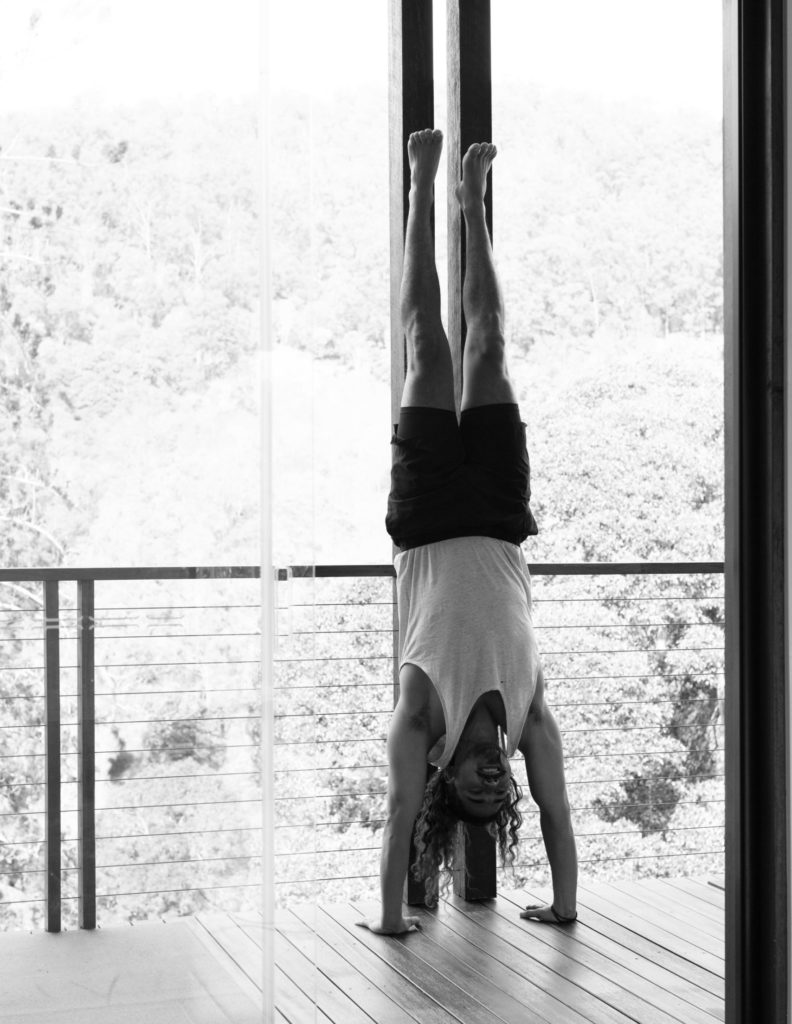
Derived from the roots Adho = down, Mukha = face, Vrksa = tree. Thus, Adho Mukha means to keep the face in a downward direction. This posture is characterised by balancing on fully extended arms so that the body is completely upside down.
How to perform Adho Mukha Vrksasana
1. Stand in Tadasana facing the wall. Then, leaning forward, place your palms on the floor at a distance of a span from the wall. Your palms should be shoulder-width away from one another and completely stretched out.
2. Gently place your hand on the floor with your middle finger facing the wall. Try to draw an imaginary line between the thumbs, aligning them where it is anatomically convenient, stretching through the membranes of all fingers and an anatomical snuffbox between the index and thumb.
3. Suction through the centre of the palms to protect the tendons and ligaments of the wrist joints, practising ha hasta bandha. This will also assist in scapular stabilisation.
4. By suctioning through the centre of the palm, you may stimulate a marma point called Tala-Hridaya marma, which governs the flow of prana from the heart to the hands, assisting the movement of Vyana Vayu, which may help in circulating lymph and blood around the body, according to yogic physiology. The inversion itself will also support the flow of lymph around the body.
5. Move your legs about halfway along with your mat, or in a tighter variation of down-face dog, feet closer to the hands. Roughly place your feet at least a metre from the hands. The easiest way from this position is to begin by lifting or kicking one leg in a straight line and letting the other follow as you gain momentum.
6. The second option, the “bunny hop”, is more complex. During exhalation, bend the knees and jump the legs upward against the wall and find your balance. If you feel tension a\in the spine, it could mean that your palms are too far from the wall. If your spine is curved into a backbend, and you feel this strain and/or are having difficulty balancing, please adjust your palm’s position closer to the wall. Breathe normally and hold this pose for a minute.
7. Once you’ve worked your balance against the wall, move your feet away from the wall, one foot at a time, until you can move both feet away from the wall. Following this, try this pose in the middle of the room, away from a wall. Make sure the legs are fully extended, the toes are bent at the dorsum (or plantar if you prefer), and the head and neck are relaxed where possible but still fairly off the ground while the arms remain straight.
Adho Mukha Vrksasana Benefits
Western Physiology
Adho Mukha Vrksasana has therapeutic effects on mental and physical health.
- Adho Mukha Vrksasana improves mental health:
- It improves symptoms of depression (Shapiro et al., 2007).
- Adho Mukha Vrksasana stretches and strengthens the muscles:
- It helps the belly or abdominal muscles to stretch.
- Adho Mukha Vrksasana strengthens the arms and wrists when practised correctly, providing a better range of motion in the shoulder joint (Fishman et al., 2006).
- Adho Mukha Vrksasana benefits the cardiovascular system:
- It induces vigorous exercise, which can promote cardiovascular endurance (Robergs et al., 2006) and, for this reason, can improve heart rate variability. Adho Mukha Vrksasana will also help reduce heart rate when practised over a long time due to the mild inversion (Hare & Ramlakhan, 2015). This is likely induced by activating the baroreceptors within the carotid arteries when the blood flows more into the neck. A longer out-breath here will also assist the relaxation response and lower stress levels. It helps calm the mind, which can relieve stress and symptoms of mild depression (Telles et al., 2009).
- The posture will increase grip strength, which predicts heart health (Leong et al., 2015).
- This pose, in tandem with others, regulates blood pressure (Cohen et al., 2013).
- Other therapeutic effects of Bhujangasana include but are not limited to:
- It helps the chest fully expand, which will assist with breathing.
- It helps improve balance.
- This inversion may be very helpful in relieving headaches. Headaches of the tension variety are often caused by vasoconstriction of the arteries. Inversions will increase arterial dilation for the bilateral internal carotid arteries (Marshall-Goebel et al., 2016). Dilation of arteries and arterioles leads to an immediate decrease in arterial blood pressure. Therefore, this gentle inversion is a great start to recovering from headaches. (Please see contradictions and cautions when suffering from migraine headaches below.)
- Adho Mukha Vrksasana may increase the circulation of lymph—a clear fluid that acts as a drainage system through the body, picking up bacteria, viruses, excess fluid and metabolic waste. These particles are collected and then removed through lymph nodes. Lymph circulation is aided by muscular contractions (Reddy, 1986). Studies have indicated that the isometric contraction of muscles during yoga increases lymph circulation (Havas et al., 1997).
- The inversion will also affect the movement of lymph through gravity. Whenever your head is below your heart, lymph moves into the respiratory organs, where germs (bacteria, viruses, fungi, and protozoa) often enter the body. Gravity drains the lymph upon returning to an upright position, sending it through your lymph nodes for cleansing.
- Breathe through your nose, which will increase nitric oxide (NO) for best results. The latter is involved in the health and function of the nervous system, having the incredible ability to kill bacteria and viruses. Furthermore, focusing mindful attention on the body’s limbs may increase the blood and lymphatic flow. This understanding comes from the science of psycho-neuro-immunology.
Yogic Physiology
- Adho Mukha Svanasana helps in recovery from fatigue, and the inversion restores pranic energy or flows in individuals who may be physically exhausted.
- Adho Mukha Vrksasana restores the flow of Udana prana from the heart to the head through the inversion.
- Adho Mukha Vrksasana restores the flow of Vyana Vayu from the heart to limbs, which may assist with reducing cold hands and feet or poor circulation.
- Adho Mukha Vrksasana may be helpful in healing headaches, sinusitis, tinnitus and depression as it may increase the flow of Tarpaka Kapha, the Kapha around the head and sinuses.
- This posture is a particularly good heart and chest opener, working on “Anahata Akash”, the heart space and the flow of energy from hands to heart and vice versa.
Contradictions and Cautions
- Avoid practising this pose if you suffer from:
- migraines (please see above for benefits to relieving some tension headaches)
- heart conditions
- menstruation
- high blood pressure that is either undiagnosed and/or unmedicated
- back, neck or shoulder injury
- Individuals suffering from carpal tunnel syndrome or sore wrists, RSI should avoid this pose.
- During pregnancy, it is wise to avoid this pose in the later stages unless practised regularly before the pregnancy.
- Detached retina or glaucoma or any condition where the eye’s intraocular pressure should not be increased. Adho Mukha Vrksasana causes an increase in intraocular pressure; therefore, people with cataracts or retinal detachments should be warned against people with cataracts (Jasien et al., 2015).
- Adho Mukha Vrksasana can cause an increase in intracranial pressure (ICP). Therefore, should be cautioned against people who have brain aneurysms, tumours or strokes or symptoms associated with increased ICP.
Preparatory Asanas
- Adho Mukha Svanasana
- Bakasana
- Pincha Mayurasana
- Plank Pose
- Supta Virasana
- Tadasana
- Uttanasana
- Virasana
Follow up Asanas
- Pincha Mayurasana
- Sirsasana
- Adho Mukha Svanasana
- Adho Mukha Virasana
Tips for Beginners
For many beginners, keeping the elbows straight may be difficult while performing this pose. If so, buckle a strap and loop it around the upper arms, just above the elbows. Stretch your arms outward at shoulder width, then tighten the yoga strap, so it fits snugly around your arms. Then, situate yourself into the pose, and focus on pushing your arms inward, away from the strap.
Variations
You can vary your hand placements in this pose to produce different effects. You can move your hands closer to each other, inside shoulder length, which will decrease the base of support and further develop your sense of balance. Alternatively, you can widen your hands further from shoulder length, which will train you in externally rotating your upper arms.
Modifications and Props
Floor Pads
The Adho Mukha Vrksasana handstand pose can be modified by placing padded support on the floor and resting the crown of your head on top of it. This will help stabilise your position and provide greater confidence. However, placing a pad at the correct height can prove difficult: if the height is too low, then your head won’t reach; if it’s too high, it will be uncomfortable for your neck, which is now compressed. A helpful method to resolve this problem is to use a yoga block as the base, then fold two or more blankets on top.
How high you build the support depends on your height and arm length. Experiment with various padded support configurations until you find the one that provides the most comfort. Once you are ready, place both hands shoulder-width apart on both sides of the support and walk in from Adho Mukha Svanasana until the crown of your head is comfortably on the support, and your back is against the wall. Then follow the above instruction to settle into the pose fully.
Yoga Belts
Take a yoga belt or strap to your elbows, loop and secure it around your arms above your elbows.
For those who hyperflex at the elbow joint, it is best to use a strap and press the elbows into the belt in an outward motion. This will prevent long-term damage to the ligaments and bones of your elbow.
For those wishing to increase the range of motion in the shoulder joint and have resistance in this area, you want to move the elbows away from the belt and try to loosen the belt as you externally rotate the upper arm.
Yoga Chairs
Using a yoga chair and practising the half variation of the posture can be an excellent place to start with confidence. Place your hands on the earth and your feet on a stable chair, creating an upside-down “L” shape with your body.
Using the chair to practise the half variation first (Ardha Vrksasana) is often more challenging than the full variation and can help you build strength in the shoulders and arms before the full inversion. If you can do the half variation, you can do the full. The half a variation requires more strength.
See preparation for handstand on chair option below on video.
Using the wall:
Walking the feet up the wall from the down-face dog position to the handstand can be a good start when trying to gain confidence. Start by having the feet in a diagonal position to the hands.
Get your kids involved! – Inversions for children using the wall
Using the wall – an easy way to get into handstand
Deepen the Asana
If you seek to deepen the pose and get a more advanced stretch, lift the head to look directly at the floor. For some, this can make the balance easier, but it will increase the spine’s extension, the back’s bend and its overall strength.
Please ensure that you do not press the base of your skull into the back of your neck. As you lift your head, provide significant space at the back of your neck.
To initiate the movement, bring your shoulder blades closer together, brace your crown against the wall, and then take one heel off the wall and extend it toward the ceiling. Then return the heel to the wall and repeat the same motion with the other heel. Finally, try to maintain balance while removing both heels from the wall.
Variations using Props
1. Place two flat bricks under the hands to provide the extra element of balance. See handstand with bricks on video.
2. Place a bolster under the hands to provide the extra element of balance. This is very challenging on the wrists. Whilst it will strengthen the muscles of the wrists, it may be good to take caution where the muscles, nerves, tendons or ligaments of the wrists, elbows or shoulders have had an injury. See the Bolster option here on video!
3. Place a bolster lengthways or vertically up the wall. Place your spine along the length of the bolster and press the back body into the bolster. Having done this, try kicking up with the spine pressing against the bolster. This will make the pose much more challenging as you will remove the body’s momentum being thrown forward, giving more work to the shoulder stabiliser muscles. Handstand with a bolster makes it harder – see on visual!
References
Shapiro, D., Cook, I. A., Davydov, D. M., Ottaviani, C., Leuchter, A. F., & Abrams, M. (2007). Yoga as a complementary treatment of depression: effects of traits and moods on treatment outcome. Evidence-based complementary and alternative medicine : eCAM, 4(4), 493–502. https://doi.org/10.1093/ecam/nel114
Fishman L, Konnoth C & Polesin A (2006). Headstand for Rotator Cuff Tear: Shîrshâsana or Surgery. Int J Yoga Therap 16, 39–47.
Robergs R et al. (2006). Physiological Responses to Yoga. J Exerc Physiol (JEPonline.
Hare M & Ramlakhan S (2015). Handstands: A treatment for supraventricular tachycardia? Arch Dis Child 100, 54–56.
Telles S, Gaur V & Balkrishna A (2009). Effect of a yoga practice session and a yoga theory session on state anxiety. Percept Mot Skills 109, 924–930
Leong DP et al. (2015). Prognostic value of grip strength: Findings from the Prospective Urban Rural Epidemiology (PURE) study. Lancet 386, 266–273.
Cohen, D. L., Bowler, A., Fisher, S. A., Norris, A., Newberg, A., Rao, H., Bhavsar, R., Detre, J. A., Tenhave, T., & Townsend, R. R. (2013). Lifestyle Modification in Blood Pressure Study II (LIMBS): study protocol of a randomized controlled trial assessing the efficacy of a 24 week structured yoga program versus lifestyle modification on blood pressure reduction. Contemporary clinical trials, 36(1), 32–40. https://doi.org/10.1016/j.cct.2013.05.010
Marshall-Goebel K, Ambarki K, Eklund A, Malm J, Mulder E, Gerlach D, Bershad E & Rittweger J (2016). Effects of short-term exposure to head-down tilt on cerebral hemodynamics: a prospective evaluation of a spaceflight analog using phase-contrast MRI. J Appl Physiol 120, 1466–1473.
Reddy NP (1986). LYMPH CIRCULATION: PHYSIOLOGY, PHARMACOLOGY, AND BIOMECHANICS. Crit Rev Biomed Eng 14, 45–91.
Havas E, Parviainen T, Vuorela J, Toivanen J, Nikula T & Vihko V (1997). Lymph flow dynamics in exercising human skeletal muscle as detected by scintography. J Physiol 504, 233–239.
Jasien J V., Jonas JB, Gustavo De Moraes C & Ritch R (2015). Intraocular pressure rise in subjects with and without glaucoma during four common yoga positions. PLoS One; DOI: 10.1371/journal.pone.0144505.