
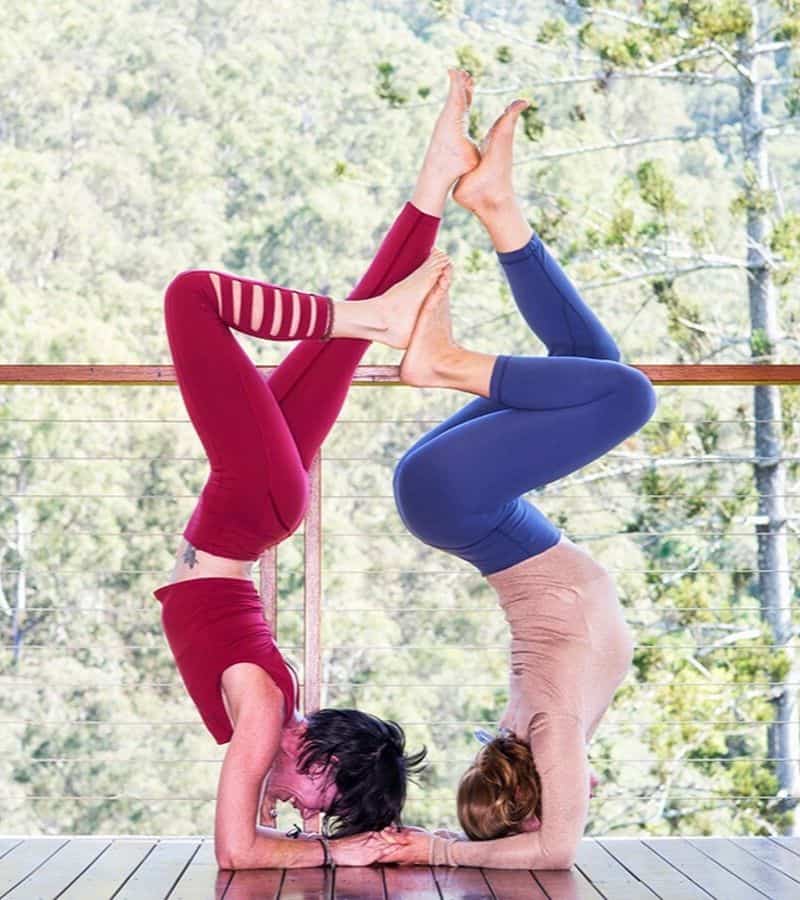
Feathered Peacock Pose.
How to perform Pincha Mayurasana
1. At your yoga wall, do a modified Adho Mukha Svanasana, with palms and forearms lying on the ground. Keep your fingertips at the base of the wall (or for an easier version, move your hands back by a hand span). Place your forearms shoulder distance apart and parallel to each other. To keep the forearms shoulder distance apart, place a brick between the hands. Although this posture has a solid base for support and the head is close to the ground, it can still be intimidating for some practitioners. To prepare for this inversion and secure yourself into it, keep your shoulder blades firm against the back portion of your body and press them toward your tailbone. Turn your upper arms outward and stretch the shoulder blades, hugging your forearms inward. Finally, stretch your palms and push your inner wrists firmly against the ground.
2. Now bend the left knee and bring the foot inside, closer to the wall, but the right leg should be kept active by extending through the heel. Then perform a couple of practice hops before you try and launch yourself in an upside-down pose. Bring your right leg in the movement of a wide arc toward the wall and kick your left foot above the ground, immediately pressing through the heel to lengthen the leg. Do the movements of hopping up and down multiple times, and try to push off the ground a little higher each time. During each hop, exhale deeply.
3. Initially, you may be able to manage only hopping up and down. However, regularly practising the strength poses such as the Adho Mukha Svanasana, Plank pose and Chaturanga Dandasana. Finally, you will be able to perform the pose. Initially, your heels may crash with force to the wall; however, with practice, you can bring your heels up softly to the wall.
4. If you have tight groins and armpits, your lower back may get deeply arched. To stretch and lengthen your lower back, draw your front ribs into your upper body, push your tailbone in the direction of your heels and take your heels higher up the wall. Pull the navel towards the spine. Squeeze your outer legs together and slide your hips inward. In Pincha Mayurasana, your head should be placed off the ground hanging from a spot lying between your shoulder blades. Your gaze should be focused on the centre of the room.
5. Hold yourself in the pose for 10-15 seconds initially. Gradually increase the duration to 1 minute. While coming down, take care to not sink onto the shoulders. Keeping your shoulder blades pulled up and stretched, bring one foot down at a time during exhalation. Remain into Adho Mukha Svanasana for 30- 60 seconds. Be sure to kick with alternate legs, one day with the right and the next with the left.
Pincha Mayurasana Benefits
Western Physiology
Pincha Mayurasana has a therapeutic effect on mental and physical health.
- Pincha Mayurasana improves mental health:
- It helps in calming and relaxing the brain.
- It helps in relieving symptoms of stress and mild depression (Evans et al., 2014).
- Pincha Mayurasana stretches and strengthens the muscles:
- It helps in strengthening the arms, shoulders and back.
- It helps in stretching the chest, shoulders and neck and belly.
- Other therapeutic effects of Pincha Mayurasana include but are not limited to:
- This pose improves the balance.
- This pose improves sleeping patterns in tandem with others (Evans et al., 2013).
- This pose, in tandem with others, improves the symptoms of Irritable Bowel Syndrome (Evans et al., 2014).
- This pose increases the blood supply to the brain, nourishing the neurons and removing toxins (Rajathi et al., 2015).
- This pose improves overall blood and lymph circulation (Rajathi et al., 2015).
Yogic Physiology
This posture falls under the Viparita family of inversions. For this reason, it challenges the opposite psychological perspective as one inverts the body. This is wonderful for anyone who needs to overcome fear or see things from a different angle.
It is great for Kapha types and builds strength for Vata types. Because it is a heating posture, Pitta types might find ways to try and lower blood pressure through longer slower outbreath through the nose, reducing flaring of the nostrils, softening the inner corners of the eyes and increasing saliva in the mouth. To cool down after the posture further, one may start practising Shitali or Sitkari (cooling) pranayama after practice.
Contradictions and Cautions
- Individuals suffering from back, shoulder or neck injuries should avoid this pose.
- Also, people having a headache, high blood pressure and any heart condition should also not perform this pose.
- Females should not do this pose during menstruation.
Preparatory Asanas
- Adho Mukha Vrksasana
- Adho Mukha Svanasana
- Gomukhasana
- Prasarita Padottanasana (with a block squeezed between the bent elbows)
- Supta Virasana
- Kapotasana
- Uttanasana
Follow up Asanas
Tips for Beginners
Many beginners find it difficult to prevent their elbows from slipping apart in this pose. Fasten the yoga belt and put it on your shoulders, just above or on the elbows. Start extending your arms straight out in front of you, shoulder-width apart, and adjust the strap so that it wraps around the outside of your arms. Then use the yoga strap in the pose, but think of pushing the arms slightly in, away from the strap, rather than letting them bulge out into the strap.
Variations
Sometimes, performing the full posture immediately may be impossible. Instead, you can do its half variation, Ardha Pincha Mayurasana (ar-dah = half), which will help you to become stronger and more confident for the full posture.
Sit on the floor, fully extend your legs and place your feet against the wall. Imagine a mark on the ground next to your thighs. Turn your back to the wall, kneel and rest the elbows on the mark. Then take the pose as described in step 1 above. Step one foot onto the wall, then push off with the other foot and lift it up alongside its mate. Now walk your feet slowly down the wall until your legs become parallel to the floor and your trunk becomes perpendicular. Press the heels strongly into the wall by lifting the upper parts of the thighs and tailbone toward the ceiling. Stay in this posture for gradually increasing lengths of time, starting with around 15 seconds and slowly working toward 1 to 2 minutes. If you find yourself strong enough to do this variation, you will be able to support yourself in the full posture.
Modifications and Props
Traditionally, in this pose, the palms are placed on the floor. However, it is possible to change the position of the forearms and hands. You will need a block to strengthen your arms. You can simplify the pose a bit by pressing your palms against the ends of the block so that your wrists are perpendicular to the floor. Remember to curl your fingers around the back of the block and then touch your fingers to the yoga wall. Actively press the inside of your wrists to the ground. Or you can turn your palms toward the ceiling with the little fingers of the hand block, which will help to learn about the rotation of the upper arms. Keep your palms alive and your thumbs bent away from the ends of the block.
Deepen the Asana
Advanced students should gradually move away from the wall and learn to balance without support.
First, sit on the floor with your legs fully extended to deepen the pose. Your feet should be pressed against the yoga wall. Imagine a mark on the ground next to your knees, then come into a pose with your elbows on that mark. Now your hands will be slightly away from the wall. Then kick up, bend your knees, and touch your feet on the wall. If you’re in the right spot, your upper arms, torso, and thighs should be aligned perpendicular to the floor and your knees at a right angle. Keep one foot on the wall and extend the other leg fully, pushing the heel actively toward the ceiling. After a few breaths, bend that knee and return the foot to the wall, then repeat with the other leg. Finally, with an inhalation, try to straighten both legs and balance.
References
Evans S, Lung KC, Seidman LC, Sternlieb B, Zeltzer LK, Tsao JC. Iyengar yoga for adolescents and young adults with irritable bowel syndrome. J Pediatr Gastroenterol Nutr. 2014 Aug;59(2):244-53. doi: 10.1097/MPG.0000000000000366. PMID: 25025601; PMCID: PMC4146428.
Evans S, Sternlieb B, Zeltzer L, Tsao J. Iyengar yoga and the use of props for pediatric chronic pain: a case study. Altern Ther Health Med. 2013 Sep-Oct;19(5):66-70. PMID: 23981408; PMCID: PMC3836371.
Rajathi Sakthivel, Rajendran Shankar Shanmugam, Noor Mohamed Usman, Somasekar Ramaswamy, Latha Rethinasabapathi. The Role of Hatha Yoga in Human Immuno Deficiency Virus (HIV)/Acquired Immuno Deficiency Syndrome (AIDS). AYUSHDHARA, 2015;2(5):368-372
If you would like to contact Celia to learn more about the meditation teacher training journey, please do visit our Meditation Teacher Training Page or find us on Facebook or Instagram or contact Celia directly.