
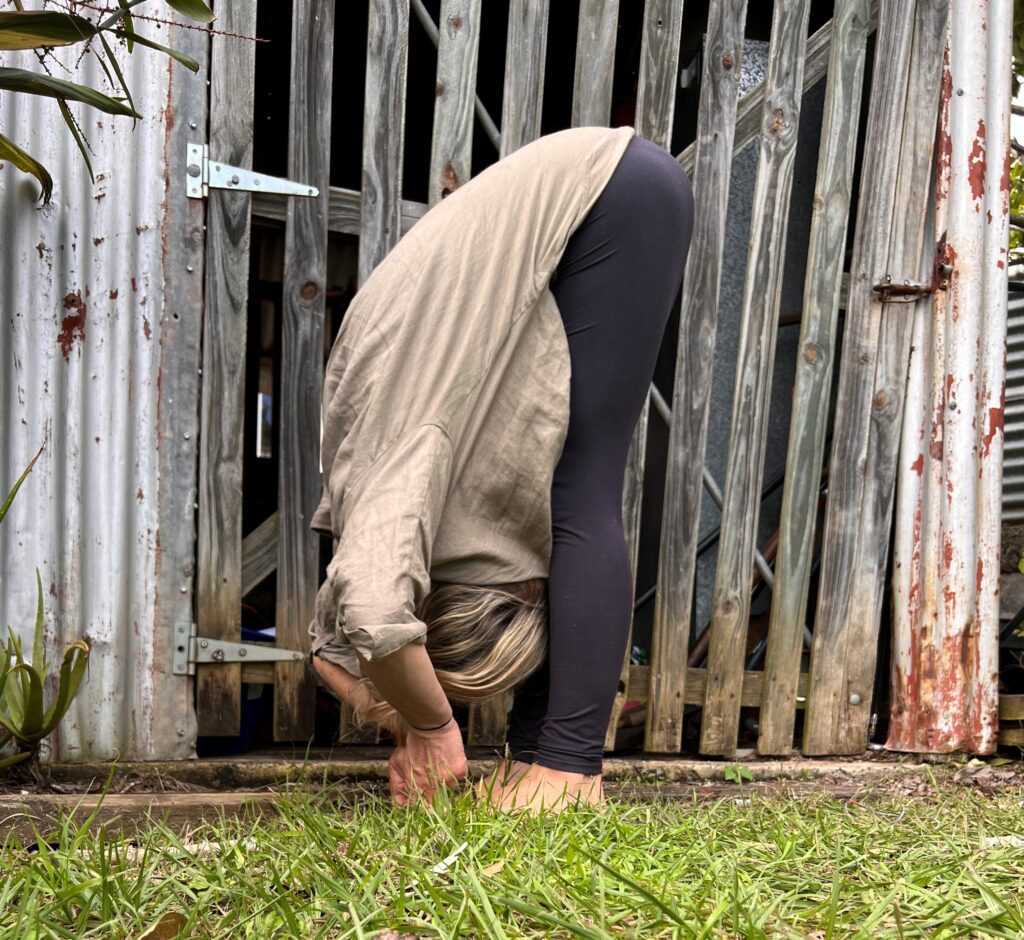
Derived from the root pada = foot, angustha = big toe and asana = pose; thus, Padangusthasana roughly translates to “Big Toe Pose”.
How to perform Padangusthasana
1. Stand straight, keeping your inner side of the feet parallel to each other, with a distance of about 15 cm apart. Lift your kneecaps by contracting the muscles of your front thigh. To create a bandha in the hips, without moving the feet, slightly squeeze your big toes together and press your heels gently apart, like you are pigeon-toed. Exhale, keep your legs straight and bend forward, moving your head and torso as a single unit. Take care to bend from your hip joints and not your waist. (Do bend your knees if you need the extra support.)
2. Place the middle and index fingers of each hand between the second and big toes of your feet. Then, hold the big toes firmly, curl those fingers under them, and wrap the thumbs around the other two fingers to secure the wrap. Push your toes down towards the floor, applying the pressure against your fingers. (If you cannot hold your toes with your back straight, put a strap under the ball of each foot and instead of the toes, hold the straps.)
3. Inhale and lift your torso in a motion as if you are going to stand up, and straighten your elbows. Lift up your sitting bones on the next exhalation, lengthening your front torso. Depending on your flexibility, a hollow will be created at your lower back to a greater or lesser degree. While doing this, switch on your hamstrings muscles by squeezing your heels together, hollow your lower belly (the region below the navel), and gently lift it toward the back side of your pelvis.
4. Relax your forehead. Pull up the top of your sternum as high as possible; however, do not pull your head as much as to compress the back of your neck.
5. Pull your torso up firmly, continuing to actively contract your front thigh muscles for the following few inhalations. At the same time, with each successive exhalation, lift your sitting bones firmly and engage your hamstrings. While doing this, the hollow created in your lower back should be deepened.
6. If your hamstrings are long, keep your forehead toward your shins. However, if your hamstrings are short, focus on lengthening the front torso. Hunching and forcing yourself forward can be dangerous for your lower back. Moreover, it serves no purpose of lengthening your hamstrings.
7. Finally, exhale and bend your elbows towards the sides, draw up on your toes, stretch the sides and front of your torso and bend forward gently.
8. The final position should be held for 1 minute. Then release the grip on your toes, keep your hands to your hips and lengthen your front torso again. Inhale and bring back your torso and head as one unit back to a straight or upright position.
Padangusthasana Benefits
Western Physiology
Padangusthasana has a therapeutic effect on mental and physical health.
- Padangusthasana improves mental health:
- It helps relieve stress and symptoms of anxiety and mild depression (Cowen & Adams, 2005; Jeter et al., 2013; Innes et al., 2012).
- Padangusthasana improves metabolism:
- It helps in the stimulation of the kidneys and liver.
- It improves and promotes digestion.
- This pose, in tandem with others, prevents central obesity (Siu et al., 2015).
- Padangusthasana stretches and strengthens the muscles:
- It helps stretch the calves and hamstrings (Van Puymbroeck et al., 2007).
- It strengthens lower back (Akademia & Fizycznego, 2016).
- It helps strengthen and stretch the thighs (Akademia & Fizycznego, 2016; Van Puymbroeck et al., 2007).
- It improves flexibility (Cowen & Adams, 2005; Van Puymbroeck et al., 2007).
- Padangusthasana benefits cardiovascular system:
- This pose, in tandem with others, improves diastolic blood pressure (Cowen & Adams, 2005).
- This pose, along with others, improves cardiorespiratory endurance (Lau et al., 2015).
- Other therapeutic effects of Padangusthasana include but are not limited to:
- It improves sleep patterns (Innes et al., 2012).
- This pose, in tandem with others, may help relieve the signs and symptoms of menopause (Problem- & Yoga, 2019).
- This pose, in tandem with others, may help relieve osteoporosis and osteopenia (Fishman, 2009; Lu et al., 2016).
Yogic Physiology
- According to Ayurveda, this posture has a calming and cooling effect on the body and mind and is therefore very good for reducing heat or pitta. It is particularly effective for vata (calming) and pitta (cooling) types. Similar to most forward bends, it soothes vata imbalances and is excellent for reducing kapha.
- This posture is excellent for the flow of apana vayu – the downward flowing prana from the lower back to the feet. It removes waste products from the pranic field and therefore, the body and mind. This downward flowing prana governs reproductive health, lower colon health, health of the bladder and urethra. It also has the effect of calming the mind and reducing mental waste. The outbreath or focus on exhalation will accentuate the downward flow.
- This posture will affect the marma point between big toe and second toe by holding and applying pressure. The marma point is called kshipra marma and massage to this marma will promote the flow of prana, particularly in the lower limbs. It also controls the lymphatic (rasavaha) and respiratory (pranavaha) systems and lubrication for heart and lungs (avalambaka kapha).
Chinese Medicine
Stretching into the back lines of the body, it affects the kidney and bladder meridian lines and also the governor vessel meridian line, associated with sushumna nadi in yoga.
Contradictions and Cautions
You should avoid this pose if you suffer from injury to the lower back or neck (Yoga Journal, 2022).
Preparatory Asanas
- Supta Padangusthasana
- Adho Mukha Svanasana
- Uttanasana
- Paschimottanasana
Follow up Poses
- Utkatasana
- Trikonasana
Tips for Beginners
If you can’t easily hold your toes with your knees straight, loop a yoga strap around the middle of each arch for a handhold instead of bending your knees (Yoga Journal, 2022).
References
Big Toe Pose. (2022). Yoga Journal. https://www.yogajournal.com/poses/big-toe-pose/
Cowen, V. S., & Adams, T. B. (2005). Physical and perceptual benefits of yoga asana practice: Results of a pilot study. Journal of Bodywork and Movement Therapies, 9(3), 211–219. https://doi.org/10.1016/j.jbmt.2004.08.001
Jeter, P. E., Cronin, S., & Khalsa, S. B. ir S. (2013). Evaluation of the benefits of a kripalu yoga program for police academy trainees: a pilot study. International Journal of Yoga Therapy, 23(1), 24–30. https://doi.org/10.17761/ijyt.23.1.3x94511x3u47n0q5
Innes, K. E., & Selfe, T. K. (2012). The Effects of a Gentle Yoga Program on Sleep, Mood, and Blood Pressure in Older Women with Restless Legs Syndrome (RLS): A Preliminary Randomized Controlled Trial. Evidence-based complementary and alternative medicine : eCAM, 2012, 294058. https://doi.org/10.1155/2012/294058
Siu, P. M., Yu, A. P., Benzie, I. F., & Woo, J. (2015). Effects of 1-year yoga on cardiovascular risk factors in middle-aged and older adults with metabolic syndrome: a randomized trial. Diabetology & metabolic syndrome, 7, 40. https://doi.org/10.1186/s13098-015-0034-3
Van Puymbroeck, M., Payne, L. L., & Hsieh, P. C. (2007). A phase I feasibility study of yoga on the physical health and coping of informal caregivers. Evidence-Based Complementary and Alternative Medicine, 4(4), 519–529. https://doi.org/10.1093/ecam/nem075
Akademia, G., & Fizycznego, W. (2016). Hatha Yoga Exercises in Prevention and Correction of Body Posture Defects At Children in School Age. April.
Lau, C., Yu, R., & Woo, J. (2015). Effects of a 12-Week Hatha Yoga Intervention on Cardiorespiratory Endurance, Muscular Strength and Endurance, and Flexibility in Hong Kong Chinese Adults: A Controlled Clinical Trial. Evidence-based complementary and alternative medicine : eCAM, 2015, 958727. https://doi.org/10.1155/2015/958727
Problem-, E., & Yoga, W. T. (2019). Women Through Yoga. 29(29), 57–64. https://doi.org/10.17761/2019-00020.Keywords
Fishman, L. M. (2009). Yoga for Osteoporosis. Topics in Geriatric Rehabilitation, 25(3), 244–250. https://doi.org/10.1097/tgr.0b013e3181b02dd6
Lu, Y. H., Rosner, B., Chang, G., & Fishman, L. M. (2016). Twelve-Minute Daily Yoga Regimen Reverses Osteoporotic Bone Loss. Topics in geriatric rehabilitation, 32(2), 81–87. https://doi.org/10.1097/TGR.0000000000000085
If you would like to contact Celia to learn more about the meditation teacher training journey, please do visit our Meditation Teacher Training Page or find us on Facebook or Instagram or contact Celia directly.